
Trade ordering for wholesalers and distributors
A B2B ordering portal your trade customers will actually use
Your customers log in, see their own prices and stock, and order when it suits them. We build and run the portal, connect it to your accounts, and quote a fixed price before work starts.
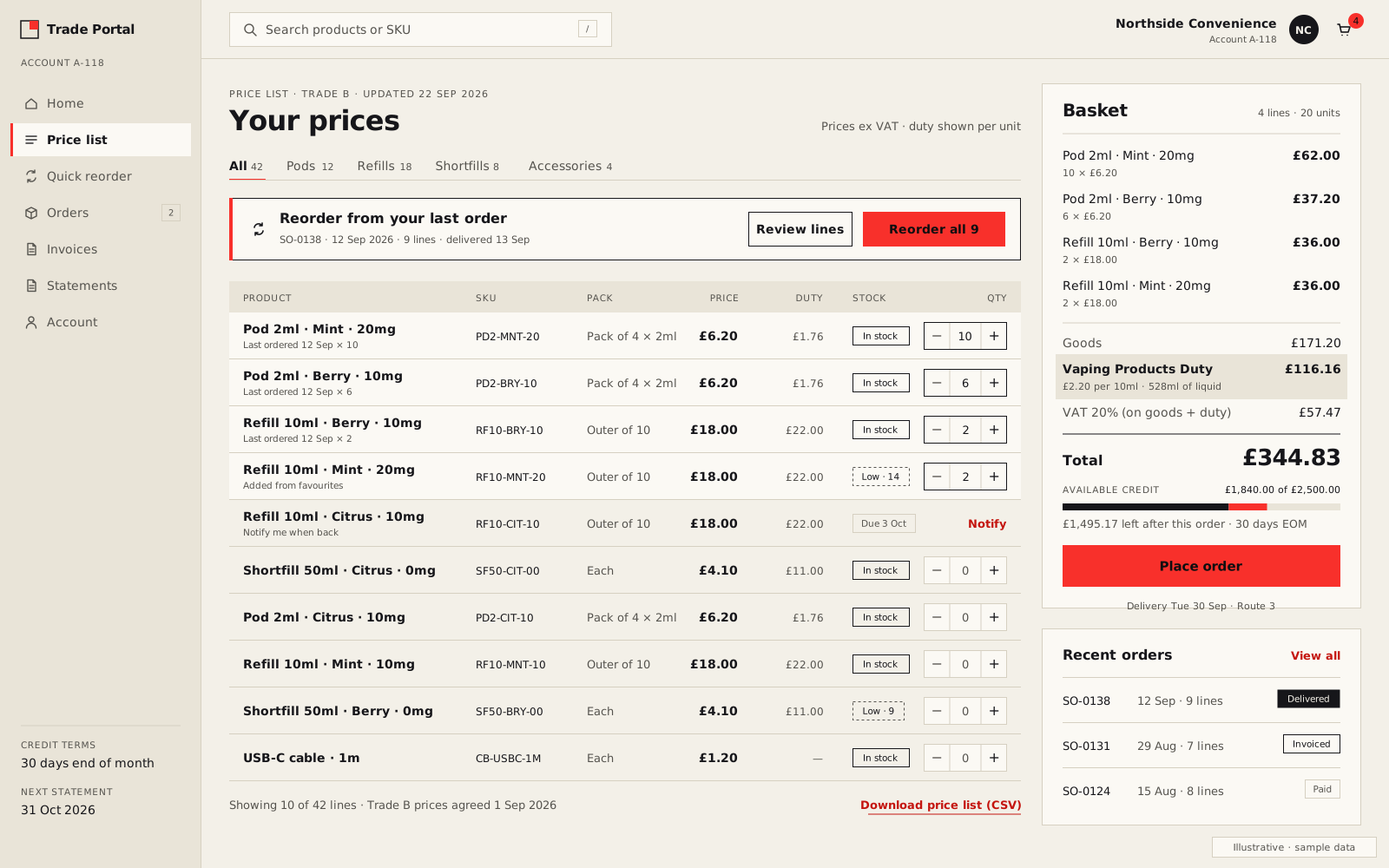
In short: a B2B ordering portal is a private site where approved trade customers see their own prices and live stock, and order without phoning you. The good ones also check new accounts, raise proper tax invoices and pass orders to your accounting system. We build portals like that, and one already runs sales and warehousing every day for a wholesaler in a tightly regulated trade.
That live system is our starting point. We adapt it to your products, price rules, warehouses and market, rather than asking you to change how you trade.
What a portal changes day to day
For most wholesalers and distributors the bottleneck isn't winning orders. It's the hours spent keying them in. The portal moves the typing to the customer, who knows exactly what they want, and it keeps taking orders overnight and across time zones.
For your customers, it means:
- their own price list, pack sizes and minimum order value;
- "order again" from past invoices, and a quick-order box for codes they know;
- stock they can see before they order, so fewer substitutions;
- invoices, statements and credit balance in one place.
For your team, orders arrive complete and priced, ready to pick. Nobody has to decode a voicemail.
Portal vs Shopify B2B vs spreadsheets and email
Shopify widened its B2B offer on 2 April 2026: company accounts, payment terms and up to three custom catalogues are now on its Basic, Grow and Advanced plans, with unlimited catalogues kept for Plus (Shopify announcement). That makes it a fair option for a small wholesaler. Here's how the three routes compare.
| Spreadsheets + email | Shopify B2B (non-Plus) | Portal built for you | |
|---|---|---|---|
| Customer-specific prices | Manual, per order | Up to 3 catalogues | Any number of price lists and rules |
| Trade-account checks | Manual | Approval, your own checks | Company and tax-number checks built into sign-up |
| Multiple warehouses and batches | Separate sheets | Locations; batch tracking needs an app | Stock by warehouse and batch |
| Accounting | Retyping | App store connectors | Your accounting system via its official API |
| Platform rules | None | Shopify's product policies apply | Your own hosting, in the region you choose |
| Cost model | Staff time | Monthly plan plus apps | Fixed build quote, then support |
If you sell regulated goods, read the platform's product policies before you commit. A hosted store can stop supporting a product category, and then your ordering channel goes with it.
Built for you, or an off-the-shelf portal?
There are good subscription portals. Orderspace publishes plans from $65 a month excluding tax, with sales-rep seats from its second tier (pricing). B2B Wave publishes plans that include a sales rep app. Pepperi focuses on field sales teams in FMCG, food and drink and similar trades, with offline order-taking.
| Choose off-the-shelf if… | Choose a portal built for you if… |
|---|---|
| Your pricing fits the vendor's price-list model | You run pricing rules the vendor can't express |
| One warehouse and simple stock | Several warehouses, batches or regulated stock |
| You want to start this month with no build | You want to own the system and host it where you choose |
| Standard integrations cover your stack | You need a specific accounting, courier or ERP link |
Our honest view: if a subscription tool fits your process today, use it. We're a better fit when the process is the problem the software has to solve.
The trade details most portal guides skip
Trade-account checks. Before a new account sees prices, the portal can check the company and its tax number against the official registers where your country offers an online lookup, and store the result against the account. Someone on your team still approves it.
Tax invoices in your country's format. Whether you charge VAT, GST or sales tax, the rules usually fix what an invoice must show: a unique number, your tax number, the customer's details, prices, the tax rate and the tax amount. Some countries also require business-to-business invoices to be registered with the tax authority. In India, for example, e-invoicing applies to taxpayers with aggregate turnover above ₹5 crore from 1 August 2023 (GST Council, Notification 10/2023–Central Tax). We generate invoices from the portal, or pass orders to accounting systems such as Xero, QuickBooks, Zoho Books or Sage through their official APIs, whichever your accountant prefers.
Credit terms and "on stop". Trade customers buy on account. The portal shows each one their limit and balance, and holds orders from accounts over limit for someone to release.
Couriers. We connect the courier or carrier you already use for labels and tracking, so the customer sees dispatch status without calling.
A buyer's checklist
Ask any supplier, including us, to show these working:
- New account: applying, being checked and approved.
- One product showing two different prices to two customers.
- Reordering from last month's invoice in under a minute.
- Stock falling in the right warehouse when an order is placed.
- The invoice appearing in your accounting system without retyping.
- An account over its credit limit being held.
- Exporting all your customers, products and orders to CSV.
If you're in the UK
The live portal runs for a UK vape wholesaler, so these details are already worked out:
- Account checks: Companies House for the company, and HMRC's Check a UK VAT number API for the VAT number. HMRC says the API exists for traders doing due diligence, and a verified check returns a reference number as proof.
- VAT invoices: HMRC lists what a full VAT invoice must show, including a unique sequential number, your VAT number, unit price, VAT rate and total VAT in sterling (VAT Notice 700/21).
- Accounting: Xero and Sage are the usual choices for smaller wholesalers, and we connect to both.
Shopify stopped supporting vape products in 2026, so vape wholesalers need another route. See our wholesale ordering software for the UK and, for vape stock, vape wholesale software.
What we build, and who builds it
Coded Idea is a software company founded in 2020. Our development team is in India and works remotely with clients in other countries; you talk to the people writing your code. We've delivered more than 500 projects across web, app and automation work.
Projects run in four steps: a 20-minute walkthrough, a fit check of your products, customers, price lists and warehouses, set-up and import on a fixed plan and timeline, then training and close support through the first weeks of live orders. Your data stays yours, hosted in the region you need and exportable to CSV at any time.
Once the portal is live, you can add a sales rep ordering app that uses the same prices and stock, or turn emailed purchase orders into draft sales orders with AI order processing.
What drives the quote
We don't publish a price list yet. You get a fixed quote after the walkthrough, with the full cost known before work starts. It mostly depends on:
- how many price lists and pricing rules you run;
- warehouses, batches and any regulated-stock rules;
- which accounting system, tax-invoice rules and courier we connect;
- how much product data needs cleaning before import;
- whether you want your own branding, domain and app-store listing.
Book a 20-minute walkthrough. Bring one order you had to retype this week and we'll show you how it would arrive through the portal.