

For builders' merchants and building supplies distributors
Software for building supplies merchants, built around quote, site and credit
Quotes that turn into orders at the agreed price, deliveries to the right site, products sold in lengths, sheets and bags, and credit checks before the lorry is loaded. We quote a fixed price before work starts.
In short: software for a building supplies merchant has to follow a job, not just a basket. A contractor asks for a quote, accepts it weeks later, wants it delivered to a site in two drops, and pays on account. That one order touches quoted prices, site addresses, units of measure, part deliveries, credit limits and VAT. We build systems that handle those steps around your existing products, accounts and yards, and connect them to the accounting system you already use.
From our side
The first thing that breaks when a wholesaler takes orders online is pack sizes: the customer orders singles, the warehouse picks cases, and the stock count drifts. On the trade portal we run day to day for a UK wholesaler, the conversion sits on the product and the person who buys the stock can change it, not a developer. Merchants have the same problem with harder units, like lengths, sheets and bags. In any demo, I'd change one supplier's pack size and check that stock, picking and the invoice all follow.
— Avi Singh, Founder
Tick what one order does in your business
Think of a typical order from a contractor account last month. Tick every step it went through between the first phone call and the invoice. The count tells you more about what you need than your branch or product numbers do.
Your ticks go into the message for you. Add your name and email, and we reply by email with where we'd start. Nothing is sent until you press send.
Four rules your system has to get right
These are the rules that catch merchants out, because the software treats every sale the same way when the law doesn't.
1. Materials only, or supply and fit? The construction VAT domestic reverse charge is about services. HMRC lists delivering materials to site, when supplied on their own, among the cases where you must not use it (HMRC, VAT domestic reverse charge for building and construction services). So a plain materials order is invoiced with normal VAT. If you also fit what you sell, HMRC's technical guide says supply and fix work "will normally be subject to the reverse charge", explains a 5% disregard both sides must agree at the start of a contract, and expects the invoice to make the reverse charge clear, for example "Customer to pay the VAT to HMRC" (HMRC, VAT reverse charge technical guide). The same guide says the reverse charge does not apply when an end user tells you in writing that they are one. Your system therefore needs to know three things per order: is there a service on it, has the customer confirmed end-user status, and what wording goes on the invoice.
2. Energy-saving materials are only zero-rated when installed. Insulation and similar products can look zero-rated in a price list copied from an installer. HMRC's VAT Notice 708/6 zero-rates the installation of specified energy-saving materials in residential accommodation and charitable buildings from 1 May 2023 to 31 March 2027, and the materials supplied by the person who installs them; supplied without installation, they are standard-rated (HMRC, VAT Notice 708/6). The VAT code belongs on the order line, decided by whether fitting is on the order, not fixed on the product.
3. Timber needs a trail both ways. A trader who buys and sells timber already on the GB market must keep records of who they buy it from and any traders they sell it to (GOV.UK, Regulations: timber and FLEGT licences). If goods-in records the supplier and every trade order records the buyer, that trail is a report, not a filing job.
4. Late payment terms that your statements can show. For business-to-business debts, statutory interest is 8% plus the Bank of England base rate unless your contract sets a different rate (GOV.UK, charging interest on commercial debt), and you can claim fixed recovery costs of £40, £70 or £100 depending on the size of the debt (GOV.UK, claim debt recovery costs). Whether you charge them is a business decision; the point is that statements and credit holds come from the same account record, so nobody has to work it out by hand.
Rules last reviewed 20 October 2026 against the GOV.UK and HMRC pages linked above. They can change, so check the linked page before relying on it.
What we build for building supplies merchants
We don't sell a boxed merchant package. We build the parts you are missing and connect them to what already works, starting from a trade portal that already runs sales and warehousing every day for a UK wholesaler in another regulated trade.
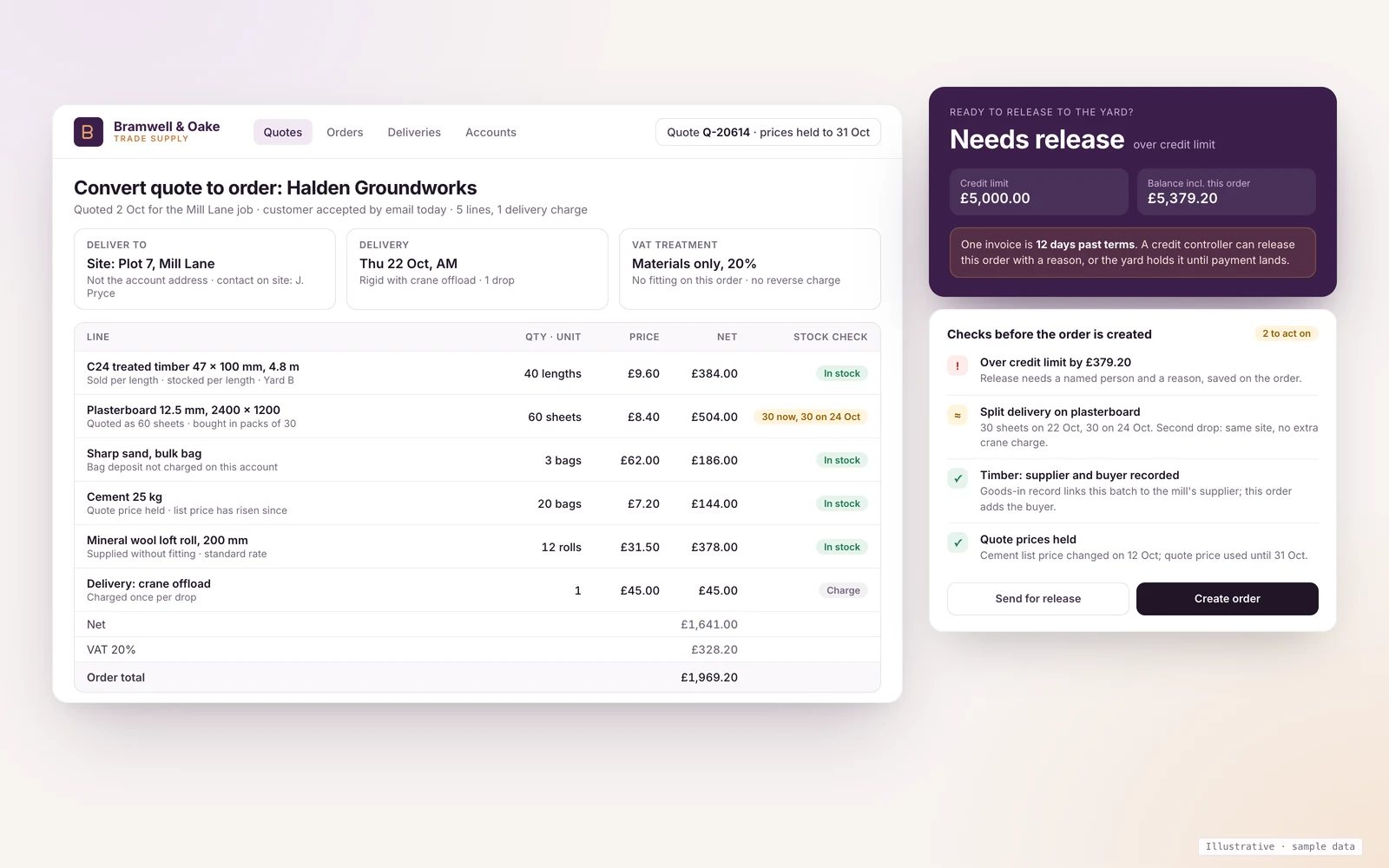
Quotes that become orders without retyping. A quote holds its prices until the date you set. When the customer accepts, it becomes an order in one step, and the system shows which lines have since changed in list price, so the counter doesn't reprice by mistake.
Site deliveries and split drops. Each account can have many site addresses with a contact and delivery notes. One order can go in more than one drop, with the back order tracked against the stock that's due in, and delivery charges set by vehicle or offload type.
Units that convert properly. Products are bought in packs, pallets or bundles and sold in lengths, sheets, square metres or bags. The conversion lives on the product, so stock, picking and invoices agree.
Credit holds with a name on them. Orders over the limit, or on accounts with overdue invoices, are taken but held. Release needs a named person and a reason, saved on the order.
One order list for every channel. Trade counter, phone, reps on site through a sales rep ordering app, and customers reordering through a B2B ordering portal. Orders that arrive as emailed purchase orders can be read by AI order processing and queued for a person to check.
Integrations. Orders become invoices in Xero, Sage, QuickBooks or another accounting system through its official API.
A merchant package or a build?
| A merchant package is likely enough if… | A build around your process fits better if… |
|---|---|
| Most sales are paid for at the counter | Most sales are on account, quoted and delivered |
| Its unit and cutting rules match your products | You sell in units the package handles awkwardly |
| Its credit rules match how you release orders | You want holds and releases recorded your way |
| Its online shop suits your trade customers | Contractors need site addresses, quotes and statements online |
Our honest view: specialist merchant systems exist and some fit well, so try one with your own quote before you buy. We are a better fit when the gaps are in how your orders flow, or when you want a trade portal on top of a system you'd rather keep. If you also distribute food or drink, see how we handle batches and dates on our food and drink distributors page, and our guide to what a B2B ordering portal costs.
Who builds it and how we start
Coded Idea is a software company founded in 2020. The development team is based in India, and we have no UK office. We have delivered more than 100 projects across web, app and automation work.
Every project starts with a 20-minute walkthrough. We then check a sample of your products, accounts, price lists and yards, agree a fixed plan and timeline for set-up and data import, and support your team closely through the first weeks of live orders. You get a fixed quote with the full cost before work starts. Your code and data stay yours, hosted in the region you choose and exportable to CSV.
Book a 20-minute walkthrough and bring one real contractor quote from last month: we'll walk it through to an invoice with you. Prefer to write first? Use the enquiry form.