
Guide · Automation costs
How much does AI automation cost? Work out your own number
On this page12 sections
Short answer: how much AI automation costs depends on five numbers, and you can work them out in about ten minutes: the volume of work, the loaded cost of the hour you are replacing, the share of items that will go through without a human, the one-off build, and the monthly run cost. Published agency ranges tell you nothing about your own job. For a reference point, our own builds start from $1,000 for one well-defined job and most single-workflow builds land between $3,000 and $8,000 — but the sum below is what tells you whether that is money worth spending. All figures on this page are in US dollars unless marked otherwise, and the model prices are vendor list prices you can check yourself.
From our side
When we built our own trade portal, the part that ate the time wasn't the AI. It was price lists that differ by customer, and stock that has to be right down to the batch. That is still true of most automation work we quote — the model reads the order fine; it's your data that decides whether the match is right. So when a quote comes back at the top of our range rather than the bottom, that groundwork is usually the reason.
— Avi Singh, Founder
The five numbers
Fill this in for one job, not for "our business". One job means one repeated task with a start and an end: keying supplier invoices, matching remittances, answering stock queries, chasing payment.
| What to write down | Where it comes from | |
|---|---|---|
| 1. Volume | Items a week, and minutes per item by hand | Count a real week, don't estimate |
| 2. Loaded hourly cost | What an hour of that person actually costs you | Wage plus employer contributions, per hour actually worked |
| 3. Straight-through share | Share of items you expect to need no human edit | Start pessimistic: 70–80% in year one |
| 4. Build | One-off: integration, data cleanup, approval screen, testing | A fixed quote, itemised |
| 5. Run | Monthly: model usage, platform or hosting, support | Model usage is usually the smallest line |
Annual saving = volume × minutes saved per item ÷ 60 × loaded hourly cost − annual run cost. Payback in months = build ÷ (annual saving ÷ 12). Nothing else in this guide changes that sum; the rest is how to get each number right.
If you are still deciding whether a job is worth automating at all, the rule of thumb we use is on our AI automation page. This guide is about the money.
Number 2 is the one people get wrong: what the hour really costs
Most cost pages compare a build price against a headline wage. That understates the saving, because an employer pays well beyond the wage. For the US, the Bureau of Labor Statistics measures this directly: in June 2026, benefits were 30.0% of total compensation across private industry and 31.5% for full-time workers, whose compensation averaged $54.00 an hour worked. Dividing a wage by 0.685 is a fair shortcut:
| Hourly wage | Loaded cost per hour worked | Annual, at 1,800 hours |
|---|---|---|
| $18 | $26.28 | $47,300 |
| $22 | $32.12 | $57,800 |
| $30 | $43.80 | $78,800 |
One detail worth knowing, because it is a common double-count: those BLS figures are per hour worked, so paid leave is already spread across them. Don't subtract holiday again.
Use the loaded figure in your sum. On the invoice job below, using the wage instead of the loaded cost pushes the payback out by about four months.
If you're in the UK
The same arithmetic with official UK figures, in pounds, because that is how the source publishes them. For a 37.5-hour week at the National Living Wage of £12.71 an hour: annual pay £24,784.50, no employer National Insurance (weekly pay of £476.63 sits just under the £481 secondary threshold — at 40 hours a week it doesn't), employer pension of £556.34, and 1,740 hours actually worked once 5.6 weeks' statutory holiday comes off. That is a loaded £14.56 an hour. On a £35,000 salary the same method gives £21.47, against a headline £17.95.
UK statutory employer costs are lower than US ones, so the loading is nearer 15–20% than 30%. Swap in your own country's employer contributions before you trust either figure.
What the AI itself costs per document
This is the line people fear and it is almost always the smallest. Model pricing is per token — roughly four characters of text — charged separately for what you send and what comes back. Taking published list prices from Anthropic's pricing documentation and a one-page order or invoice at about 2,000 input and 600 output tokens:
| Model (list price) | Per document | Per 1,000 documents |
|---|---|---|
| Haiku 4.5 ($1 / $5 per million) | $0.005 | $5 |
| Sonnet 5 ($2 / $10 per million) | $0.010 | $10 |
| Opus 5.5 ($4 / $20 per million) | $0.020 | $20 |
Anthropic's own documented example lands in the same place: about $37 to handle 10,000 support conversations on Haiku 4.5 at roughly 3,700 tokens each. Three things move those figures in practice. Batch processing, for work that doesn't need an instant answer, is half price. Prompt caching charges repeated instructions at a tenth of the input rate once cached. And scanned or photographed documents are billed as image input, so a phone photo of a delivery note costs more than the same note as text.
List prices exclude tax and change — check the vendor's page on the day you build your budget rather than trusting a number in any guide, including this one.
Three costs that rarely appear in a quote
The exception queue. An automation that handles 80% of items straight through still needs someone on the other 20%, and that person is a permanent cost, not a transition cost. Quote the saving on the difference, never on the whole job.
Data cleanup. Matching an order line to the right SKU needs product codes, pack sizes, customer price lists and unit conversions that agree with each other. On the jobs we are asked to automate, this is regularly the largest single item in the build, and it is work no model does for you.
Change after launch. A supplier changes their invoice layout, you add a warehouse, a price list gains a tier. Ask what a change costs before you sign, not after.
The one official survey of what businesses really spend
Almost every cost page quotes ranges with no source behind them. The UK's Department for Science, Innovation and Technology published AI adoption research with fieldwork from February to May 2025 — the only government survey we have found that asks businesses what they actually spent. Figures are in pounds and cover UK businesses using or planning to use AI:
| Finding | Figure |
|---|---|
| Reported no AI-related spending in 2024 | 31% (27% of current users) |
| Could not say what they had spent | 35% |
| Spent under £1,000 | 11% |
| Spent £1,000–£9,999 | 16% |
| Spent over £10,000 | 7% |
| Mean / median spend among those giving a figure | £19,000 / £2,000 |
| Planning adoption within a year with no specific budget set | 47% |
Read the gap between that mean and median carefully. A few organisations spend heavily and pull the average up; the typical buyer spends low thousands. Cost was cited as a barrier by 23% of businesses, and of those who raised it, 76% called it significant — 90% among large organisations against 72% among micro businesses. Expect the same shape in any market: a long tail of small, specific builds and a handful of expensive programmes setting the averages.
Two line items to budget that nobody advertises
A privacy impact assessment, where personal data is involved. The UK Information Commissioner's position is a useful benchmark even outside the UK: the use of AI will, in the vast majority of cases, involve processing likely to result in a high risk to people's rights, and an impact assessment is required where innovative technology — AI included — is combined with another high-risk criterion. The regulator also tells organisations not to underestimate the initial and ongoing resource this takes. That is internal time or a fee, and it belongs in the budget.
Not the tax credit. It is tempting to net research relief off the cost. The UK test, as one example, is an advance in science or technology achieved by resolving technological uncertainty, and minor or routine upgrades are excluded. Wiring a documented API to your order system is integration, not research. Ask your accountant in your own country first.
A worked example, end to end
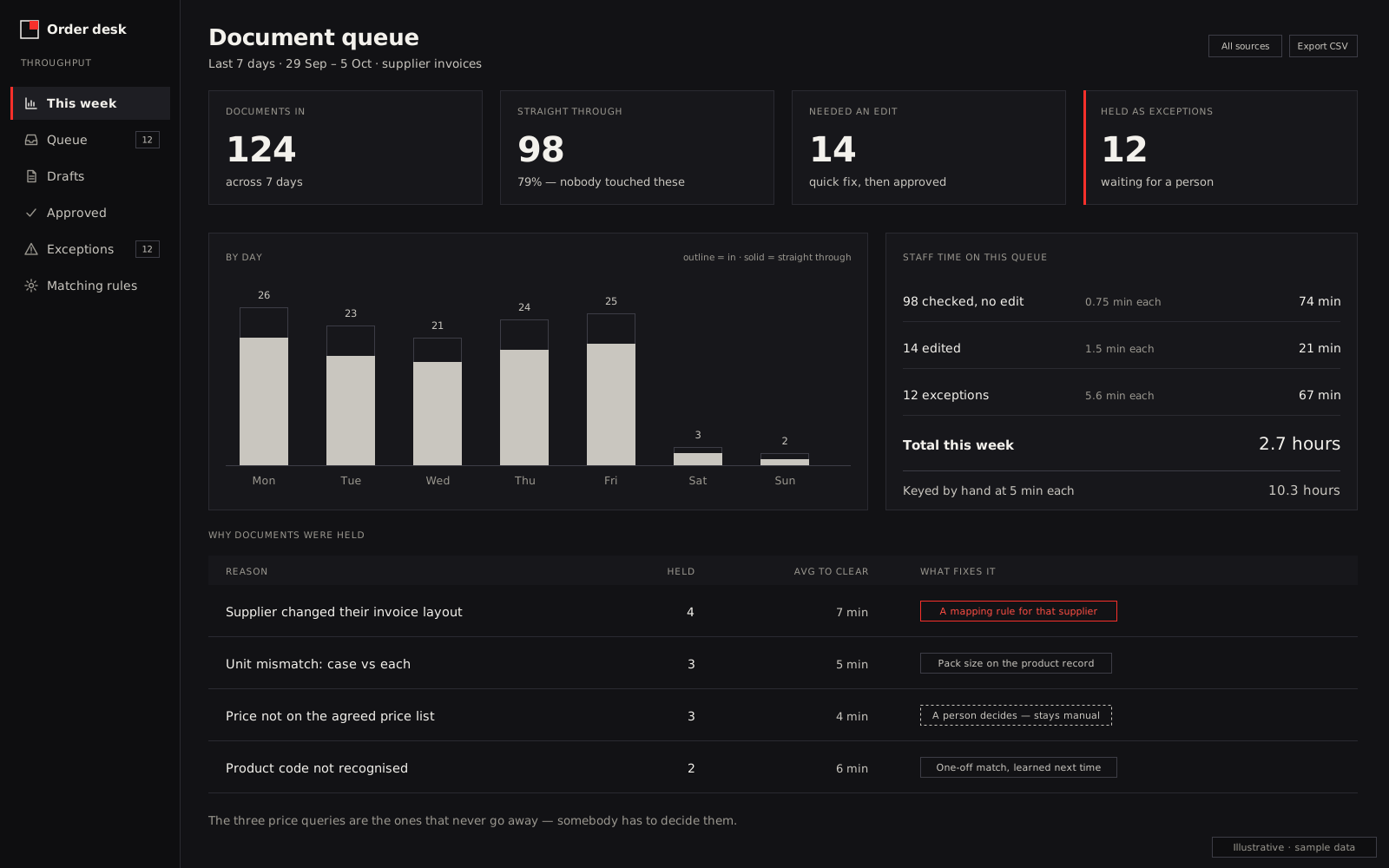
Hypothetical figures, not a client result. A distributor keys 120 supplier invoices a week, five minutes each: 10 hours a week, 520 hours a year. At the $32.12 loaded rate from the table above — a $22-an-hour accounts clerk — that hand-keying costs about $16,700 a year.
After automation, assume 80% straight through at 45 seconds of checking and 20% exceptions at six minutes:
| Weekly minutes | |
|---|---|
| 96 invoices checked at 0.75 min | 72 |
| 24 exceptions at 6 min | 144 |
| Total after | 216 (3.6 hours) |
| Before | 600 (10 hours) |
| Saved | 384 (6.4 hours) |
That is 333 hours a year, about $10,700. Model usage at $0.01 an invoice runs to roughly $62 a year — 0.6% of the saving. Allow $400 for hosting and platform fees and the net saving is near $10,300. At the top of our range, an $8,000 build pays back in about nine months; a $4,000 one in about five.
Notice what moved the answer: the loaded hourly rate and the straight-through share, not the build price. At 60% straight through instead of 80%, the same $8,000 build takes about 14 months rather than nine. That is the number to challenge in any proposal, and the reason we would rather measure a real week with you than quote from a template.
What a quote should itemise
Ask for these as separate lines. If they arrive as one figure, the risk is yours.
- Integration, priced per system, with a note on whether each one has a usable API. A system without an API is the single biggest multiplier on a quote.
- Data cleanup, priced separately — product codes, pack sizes, price lists, customer matching. If this is missing from the quote, either it hasn't been scoped or you are doing it.
- The approval screen, and who is allowed to override what.
- Testing against a real backlog of your own documents, not samples that were picked because they work.
- Run costs at your volume: model usage and platform or hosting fees, estimated from the number of documents you actually process.
- Support, and the price of a change after launch — a new supplier layout, an extra warehouse.
- Who owns the code, the data and the accounts, and what happens to the automation if you stop paying.
How we price it
Automations start from $1,000 for a single, well-defined job — one source of documents, one system to write into, one approval step. Most single-workflow builds come out between $3,000 and $8,000. The four things that decide where a job sits in that range are the ones in the checklist above: how many systems have to talk to each other, whether each of them has a usable API, how much of your product, price and customer data needs tidying before any matching will work, and how many people have to approve something before it moves. Bigger programmes — several workflows, a portal, a rebuild of the system underneath — are quoted on their own and are not what these figures describe.
We give a fixed quote after a 20-minute walkthrough, so the full cost is known before work starts, with run costs such as model usage listed separately rather than buried in a retainer. The route is the same each time: walkthrough, fit check, a fixed plan and timeline, then training and close support through the first weeks of real use. Our development team is in India, we work across time zones, and you talk to the people building the thing.
If the sum doesn't work, we would rather say so on the call. Book a 20-minute walkthrough or send the numbers you have. For what we automate first and why, see AI automation for business; for the order-entry case in detail, see AI order processing; the rest of our guides cover UK and UAE compliance deadlines.
Sources
- US Bureau of Labor Statistics, Employer Costs for Employee Compensation (June 2026)
- DSIT and DBIST, AI Adoption Research (updated 13 February 2026; fieldwork 12 February – 2 May 2025)
- Anthropic, Claude model pricing (list prices, US dollars, accessed 6 October 2026)
- GOV.UK, National Minimum Wage and National Living Wage rates (rates in force from 1 April 2026)
- GOV.UK, National Insurance rates and categories (tax year 6 April 2026 to 5 April 2027)
- GOV.UK, Workplace pensions: what you, your employer and the government pay
- GOV.UK, Holiday entitlement (5.6 weeks' statutory paid holiday)
- HMRC, Research and Development (R&D) tax relief
- ICO, What are the accountability and governance implications of AI?
- ICO, Examples of processing 'likely to result in high risk'
Last reviewed 6 October 2026. Dollar figures are vendor list prices or official statistics that change without notice, and we have not converted between currencies. This guide isn't tax, legal or data-protection advice; the ICO's AI guidance is itself under review following the Data (Use and Access) Act.