

Guide + readiness check · UAE VAT returns
UAE VAT return guide: what each VAT 201 box needs from your system
On this page6 sections
Short answer: a UAE VAT return (form VAT 201) is filed in EmaraTax within 28 days of the end of each tax period. It is quick to type in and slow to prepare, because each box needs a figure your billing and accounting system has to produce: standard-rated sales split by emirate, zero-rated and exempt sales kept apart, reverse-charge purchases tagged, imports reconciled to customs, and only the VAT you can actually recover. This guide goes box by box and says what your system has to output for each one, using the FTA's own user guides. It covers data and process only. For tax treatment, ask your tax adviser.
Check your return prep
Tick each item your system produces today without anyone editing a spreadsheet. The result shows which boxes are still being built by hand.
Your answers go into the message for you. Add your name and email, and we reply by email with which boxes your system could fill and how. Nothing is sent until you press send.
The check runs in your browser. Nothing you tick is sent anywhere unless you choose to send it.
VAT 201 box by box: what your system must output
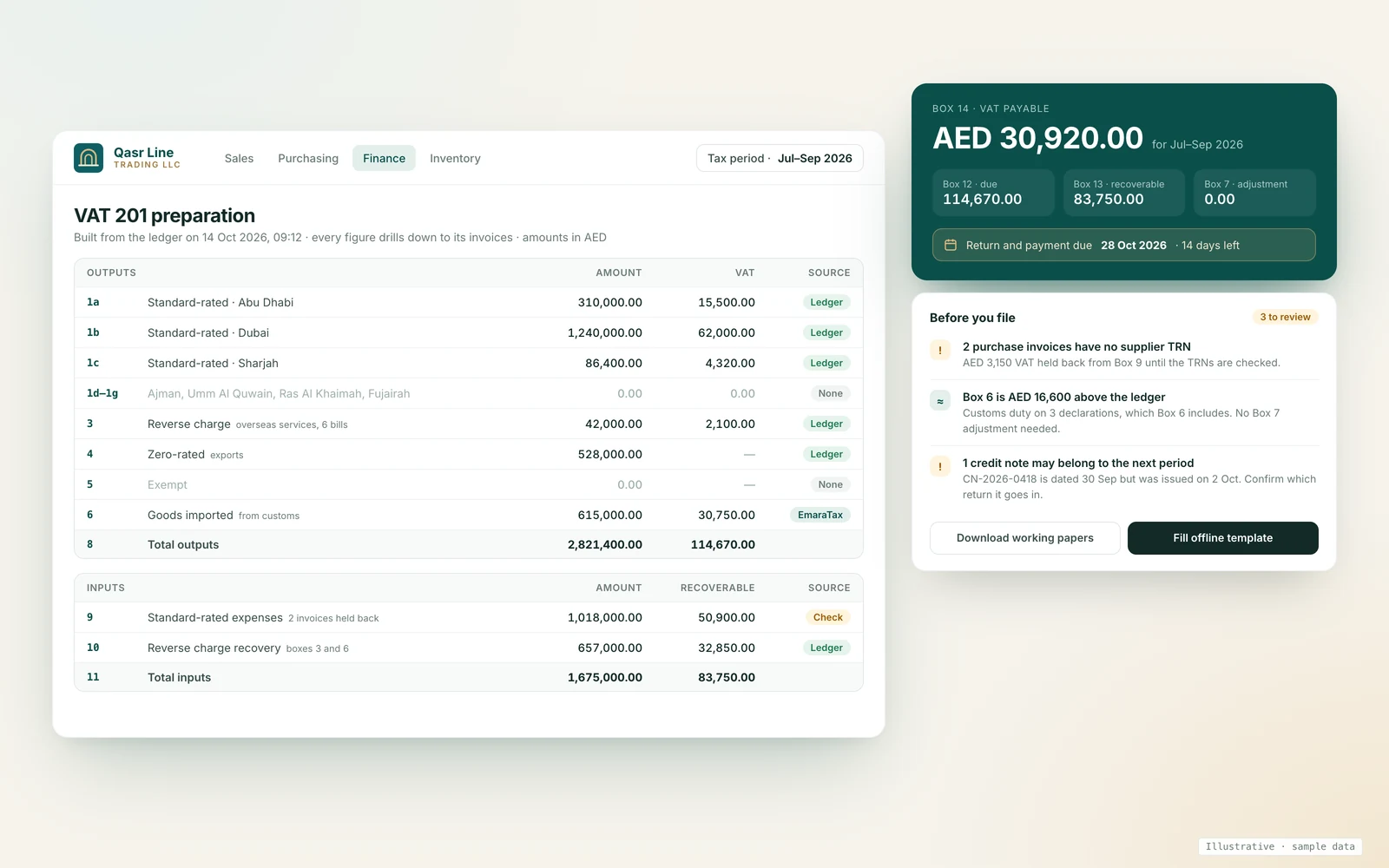
The table follows the FTA's VAT returns user guide and the current EmaraTax VAT 201 user manual. Amounts are net of VAT unless the column says otherwise.
| Box | What it holds | What your system has to produce |
|---|---|---|
| 1a–1g | Standard-rated (5%) supplies and their VAT, one line per emirate | Sales totals by emirate, taken from the establishment each invoice belongs to, net of credit notes, plus bad-debt and commercial-property adjustments in their own column |
| 2 | Tourist refunds | Nothing: pre-filled for retailers in the tourist refund scheme |
| 3 | Purchases under the reverse charge, such as services from abroad | A tagged list of reverse-charge purchases and their VAT, excluding imports of goods already in Box 6 |
| 4 | Zero-rated supplies, such as exports | Net value of zero-rated sales, separate from exempt |
| 5 | Exempt supplies | Net value of exempt sales |
| 6 | Goods imported through UAE customs | Nothing to type: pre-filled from customs. Your import records, to check it |
| 7 | Corrections to Box 6 | The difference between your import records and Box 6, with the declarations to back it up |
| 8 | Total outputs | Calculated |
| 9 | Standard-rated purchases with recoverable VAT | Only the VAT you're entitled to recover, with blocked costs left out, and adjustments in their own column |
| 10 | Recovery of reverse-charge VAT | The recoverable part of the VAT declared in boxes 3, 6 and 7 |
| 11–14 | Total inputs, tax due, tax recoverable, payable or refundable | Calculated |
Two details catch systems out. Box 1 asks for the emirate of your establishment, not your customer's address. The FTA's guide says a business with a fixed establishment reports each sale in the emirate of the establishment most closely connected to it. A system that only stores the customer address can't produce boxes 1a to 1g on its own. Box 6 includes more than the goods value: the guide says it includes customs duty and any excise tax paid on the import, so a reconciliation that compares Box 6 with supplier invoices alone will always show a gap.
What changed in 2026
No more self-invoices under the reverse charge. The Ministry of Finance announced that Federal Decree-Law No. 16 of 2025 took effect on 1 January 2026. It relieves businesses from issuing self-invoices when they apply the reverse charge, while still requiring them to keep the supporting documents. For your system, that means the reverse-charge flag and the supplier's documents now carry the evidence that used to sit in a self-invoice. Box 3 and Box 10 work as before.
A five-year limit on reclaiming excess refundable tax. The same amendment introduces a five-year time limit for requests to reclaim excess refundable tax after reconciliation. Once it passes, the right to reclaim expires. If your returns regularly end in a refund position, your system should show each period's balance and its age.
Input tax can be refused if a supply is part of evasion. The FTA may deny input tax where a supply forms part of a tax-evasion arrangement, and businesses must check that supplies are legitimate before deducting. In practice, keep the supplier's TRN check and the documents for each purchase claimed in Box 9.
New penalty amounts from 14 April 2026. Cabinet Decision No. 129 of 2025 amended the penalty table. See the next section.
Deadlines and penalties
The FTA's guidance on filing VAT returns and making payments sets the deadline: the return and any payment must reach the FTA within 28 days of the end of the tax period. You file in EmaraTax by typing the figures in or by uploading the FTA's offline template, which the EmaraTax manual describes. The penalties below come from Cabinet Decision No. 40 of 2017 as amended, with the table updated by Cabinet Decision No. 129 of 2025, in force since 14 April 2026.
| Violation | Penalty |
|---|---|
| Return not filed on time | AED 1,000 the first time; AED 2,000 for a repeat within 24 months |
| Tax not paid on time | Monthly penalty at 14% a year on the unpaid tax, from the day after the due date |
| Incorrect return | AED 500, unless you correct it before the filing deadline, or submit a voluntary disclosure that doesn't change the tax due |
| Voluntary disclosure that changes the tax | Monthly penalty of 1% on the tax difference, with further conditions in the decision |
Small errors from earlier periods can often go into the current return instead of a voluntary disclosure. The FTA's 2021 user guide sets the line at a tax difference of AED 10,000. Check the current rule with your adviser before relying on it, because the tax procedures law was also amended for 2026.
Where the hours go, and what to automate
Typing a return into EmaraTax takes minutes. Preparing it is where the time goes:
- Tag at source. Every sales invoice carries an emirate (from the establishment), a VAT treatment (standard, zero-rated, exempt, out of scope) and a link to any credit note. Every purchase carries a reverse-charge flag and a recoverable or blocked flag.
- One report per box, with a drill-down to the transactions behind it. If a number can't be traced to invoices, it can't be defended in an audit.
- An exceptions list before the deadline: purchases without a supplier TRN, credit notes dated in the wrong period, sales with no emirate, imports not in Box 6.
- Box 6 reconciliation against your own import records, including duty and excise, so Box 7 adjustments come with their declarations.
- The offline template filled from the reports, so nobody retypes a figure.
- Each return saved with its working, and refund balances tracked by age, given the five-year limit.
The same tagging is what UAE e-invoicing will need from 2027: an invoice that knows its own VAT treatment is easier to send to an accredited service provider and easier to report. If you are reviewing invoice content too, our guide to UAE tax invoice requirements lists what each invoice must show.
We build this kind of reporting and integration into billing, ERP and accounting systems through their official APIs, as part of custom software or the systems we build for UAE businesses. Every build starts with a 20-minute walkthrough and a fixed quote, then a fit check, set-up and close support through the first returns. Our development team is in India, and we don't give tax advice: we make your system produce what your adviser and the FTA ask for.
Book a 20-minute walkthrough or send us how your return is prepared today, and we'll tell you which boxes your system could fill on its own.
Sources
- FTA, VAT Returns User Guide (version 4.0, 2021): box-by-box content
- FTA, VAT Returns form VAT 201: Taxpayer User Manual (EmaraTax, October 2022): pre-filled boxes 2 and 6, offline template
- FTA, Filing VAT returns and making payments
- Ministry of Finance, VAT law amendments from January 2026 (3 December 2025): Federal Decree-Law No. 16 of 2025
- FTA, Cabinet Decision No. 40 of 2017 and its amendments (consolidated, including Cabinet Decision No. 129 of 2025, effective 14 April 2026)
- UAE Government portal, File VAT returns
Last reviewed 14 October 2026. This guide explains what the FTA's forms and guides ask for so that your systems can produce it. It isn't tax advice; for the treatment of a specific supply, ask a registered tax agent or your adviser.