

Guide + range check · Single-use vapes
Single-use vape ban: check your range, clear what's left, keep the evidence
On this page8 sections
Short answer: the single-use vape ban has applied across the UK since 1 June 2025, to wholesalers and importers as well as shops. A vape is only legal to sell if its battery recharges, it can be refilled, and any coil can be removed and replaced, with refills and coils available to buy separately. Sixteen months in, the risk for a wholesaler isn't the obvious disposables. It's the devices that look reusable but have a sealed coil, and having no evidence on file for the lines that do pass. Check each line below, take the failures off sale for registered recycling, and keep the proof against the product record.
Check one product line
Pick one line from your range, ideally a newer device. Tick what's true. The check uses the three tests in government guidance, plus the evidence it says you must be able to show.
Your answers go into the message for you. Add your name and email, and we reply by email with how this check can sit on each product record. Nothing is sent until you press send.
The check runs in your browser. Nothing you tick is sent anywhere unless you choose to send it.
The test that catches people out: the coil
Most single-use devices fail the battery or refill test, and they were cleared from ranges in 2025. The lines that still get stocked by mistake are the ones that recharge and refill but have a coil sealed into the device. Government guidance says the coil must be removable and replaceable, so a device whose coil can't be replaced once it burns out fails that test, however it charges or refills.
The second trap is the parts test. Guidance says refills and replacement coils should be available to buy separately. For a wholesaler, the cleanest evidence is your own catalogue: the device, its pods or tank refills, and its coils, listed and linked. A device whose parts you don't stock and can't point to elsewhere is a line you'll struggle to defend.
For nicotine products, the MHRA notified products list is the first check. Products with no nicotine aren't on it, so for those your own evidence is all you have.
Leftover stock: what the guidance actually requires
The rules on stock you can no longer sell are short, and they leave little room for interpretation. From the government guidance for businesses:
| Step | What to do | What to keep |
|---|---|---|
| 1. Stop it selling | Take the lines off sale online and in any trade counter | Date and who blocked it |
| 2. Separate it | Keep it apart from other goods | Location and quantity |
| 3. Label it | Mark it as unsellable | Photo of the labelled stock |
| 4. Recycle it | Arrange collection by a registered vape recycling service | Collection note and waste paperwork |
It is illegal to stock single-use vapes you plan to sell or supply, so step 1 matters most: a line that is still orderable on your portal or price list is a line offered for supply. The guidance says nothing about selling leftover stock for export or back to a supplier, so don't build a plan on either without asking your local Trading Standards service first.
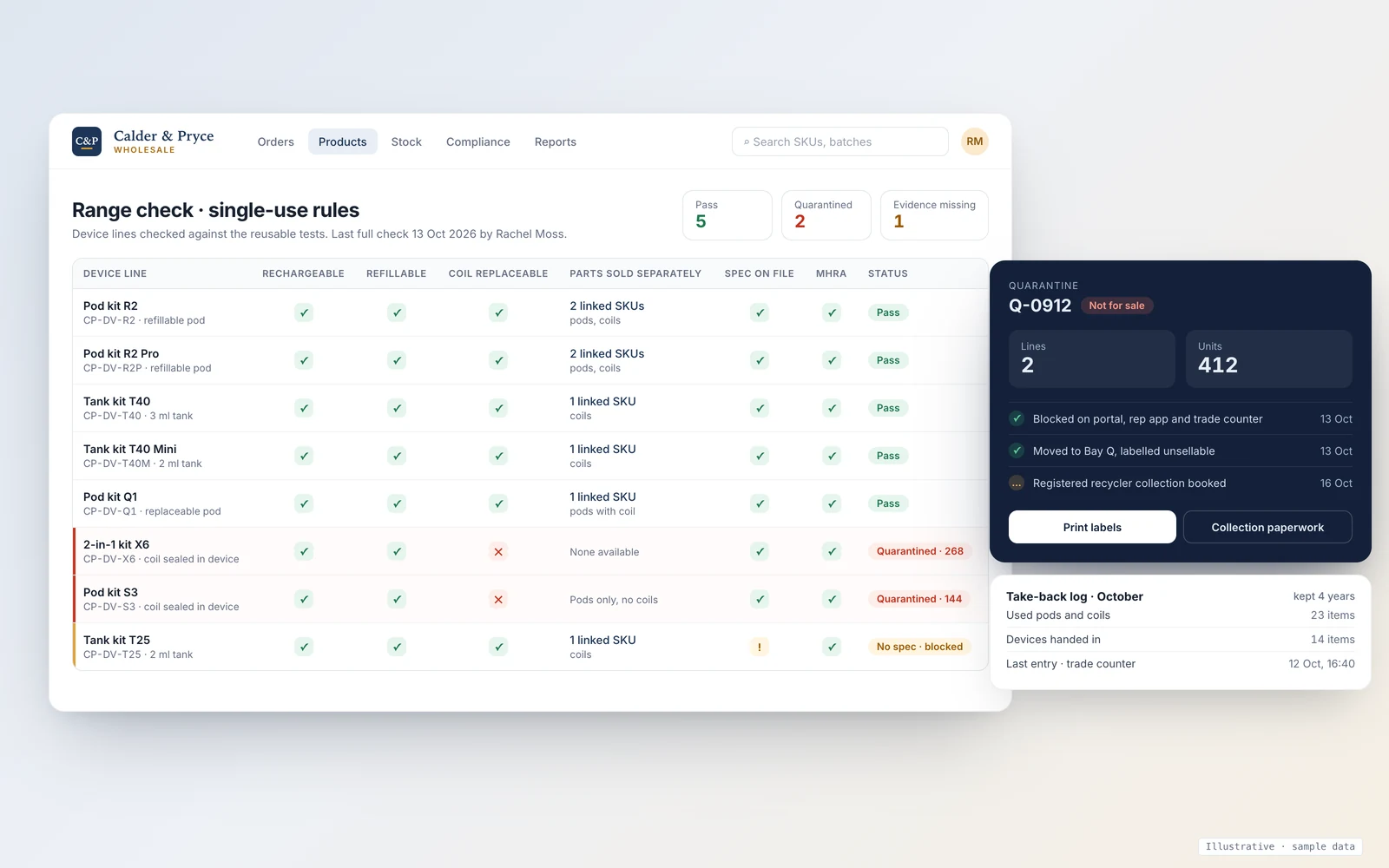
Take-back: the duty that outlived the ban
The ban ended sales of single-use devices. It did not end your recycling duties. Government guidance treats anyone who sells vapes as a distributor under the waste electricals (WEEE) regulations, and three points apply to vape sellers specifically:
- Free take-back. You must offer to take back vapes and vape parts, including single-use vapes handed in after 1 June 2025.
- No scheme to hide behind. Since the guidance was updated in August 2025, vape retailers are excluded from the Distributor Takeback Scheme, which smaller electrical sellers otherwise use instead of in-store take-back.
- Four years of records. Distributors must keep a record of all waste equipment taken back for at least four years.
The guidance aims take-back at household customers, and whether a purely trade sale counts depends on how your equipment is classed. The government publishes separate guidance on telling B2B and B2C equipment apart. If you also sell to the public, through a cash-and-carry or online, assume the duty applies.
If you import or own-brand: you're also a producer
Importing electrical equipment commercially, or selling it under your own brand, makes you a producer under the same regulations. Per the producer responsibility guidance:
| If you place on the UK market… | You must |
|---|---|
| Under 5 tonnes a year | Register as a small producer, by 31 January each year or within 28 days of first placing products on the market |
| 5 tonnes or more | Join a producer compliance scheme by 15 November each year, or within 28 days if you start later |
| Any amount | Mark products with the crossed-out wheeled bin symbol and keep records of what you place on the market, by category, for at least four years |
The August 2025 update added e-cigarettes and vapes as a product category of their own, taking the list from 14 categories to 15. If your compliance scheme or regulator return still has vapes under another category, ask them which numbering applies.
Fines by nation
The ban is UK-wide, but each nation enforces its own regulations. From the government guidance:
| Nation | First response | At the top end |
|---|---|---|
| England | Stop notice, compliance notice or a £200 fine; stock can be seized | Unlimited fine and up to 2 years in prison, plus investigation costs |
| Wales | £200 fixed fine or a variable fine, non-compliance penalty, stop notice, cost recovery | Unlimited fine and up to 6 months (magistrates) or 2 years (Crown Court) |
| Scotland | £200 fixed penalty, £150 if paid within 14 days; higher for repeat action | Fine up to £5,000 on summary conviction; up to 2 years on indictment |
| Northern Ireland | No civil sanctions | Fine up to £5,000 on summary conviction; up to 2 years in the Crown Court |
In England the offence is set out in the Environmental Protection (Single-use Vapes) (England) Regulations 2024, which local authorities enforce through Trading Standards.
What your stock system should do about it
A spreadsheet can carry this for a few lines. Across a full range, with new models arriving every month, the rules belong on the product record, where they can stop a sale rather than explain one afterwards. What we'd build in, and what we'd ask any supplier to show you:
- Reusable test fields on every device SKU: rechargeable, refillable, coil replaceable, linked refill and coil SKUs. A device can't go on sale until all four are filled in.
- Evidence attached to the record: spec sheet, photo, MHRA notification ID, who checked it and when.
- A blocked status that stops ordering everywhere: portal, rep app and trade counter at once.
- A quarantine location with its own stock count, labels and a collection record for the recycler.
- A take-back log with dates, items and quantities, kept for four years and exportable.
- The same record carries duty status, so the duty-stamp checks at goods-in and the run-down of unstamped stock work from one product list.
We build trade portals and stock systems to this shape. One we built covers sales and warehousing and is used every day by a UK wholesaler. Anything beyond that, such as the quarantine and take-back records, is something we build to your process, and every build starts with a 20-minute walkthrough and a fixed quote, followed by a fit check, set-up and import, then training and close support. Our development team is in India. For the wider picture, see vape wholesale software for the UK.
Book a 20-minute walkthrough or send us your product list, and we'll show you how the range check above would sit on every SKU.
Sources
- DEFRA, Single-use vapes ban: information for businesses (updated 3 July 2025)
- The Environmental Protection (Single-use Vapes) (England) Regulations 2024 (SI 2024/1216)
- DEFRA and Environment Agency, Waste electrical and electronic equipment (WEEE) regulations (updated 12 August 2025)
- Electrical and electronic equipment (EEE): producer responsibilities (updated 12 August 2025)
- MHRA, E-cigarettes: regulations for consumer products
- GOV.UK, Find your local Trading Standards office
Last reviewed 13 October 2026. This guide summarises government guidance for wholesalers. It isn't legal advice; for a specific product or stock question, ask your local Trading Standards service.