

Guide · Trade ordering costs
B2B ordering portal cost: what you'll actually pay over three years
On this page9 sections
Short answer: a B2B ordering portal costs either a monthly subscription that rises in steps as you add sales reps, price lists or volume, or a one-off build plus hosting and support. The price tag on either route rarely decides it. What decides it is the step-ups. Customer-specific prices, extra warehouses, sales reps and the link to your accounting system push you up a subscription tier or add lines to a build quote. Compare the two routes over three years, line by line, using the worksheet below. We don't publish a portal price list, and this guide explains why it would mislead you if we did.
From our side
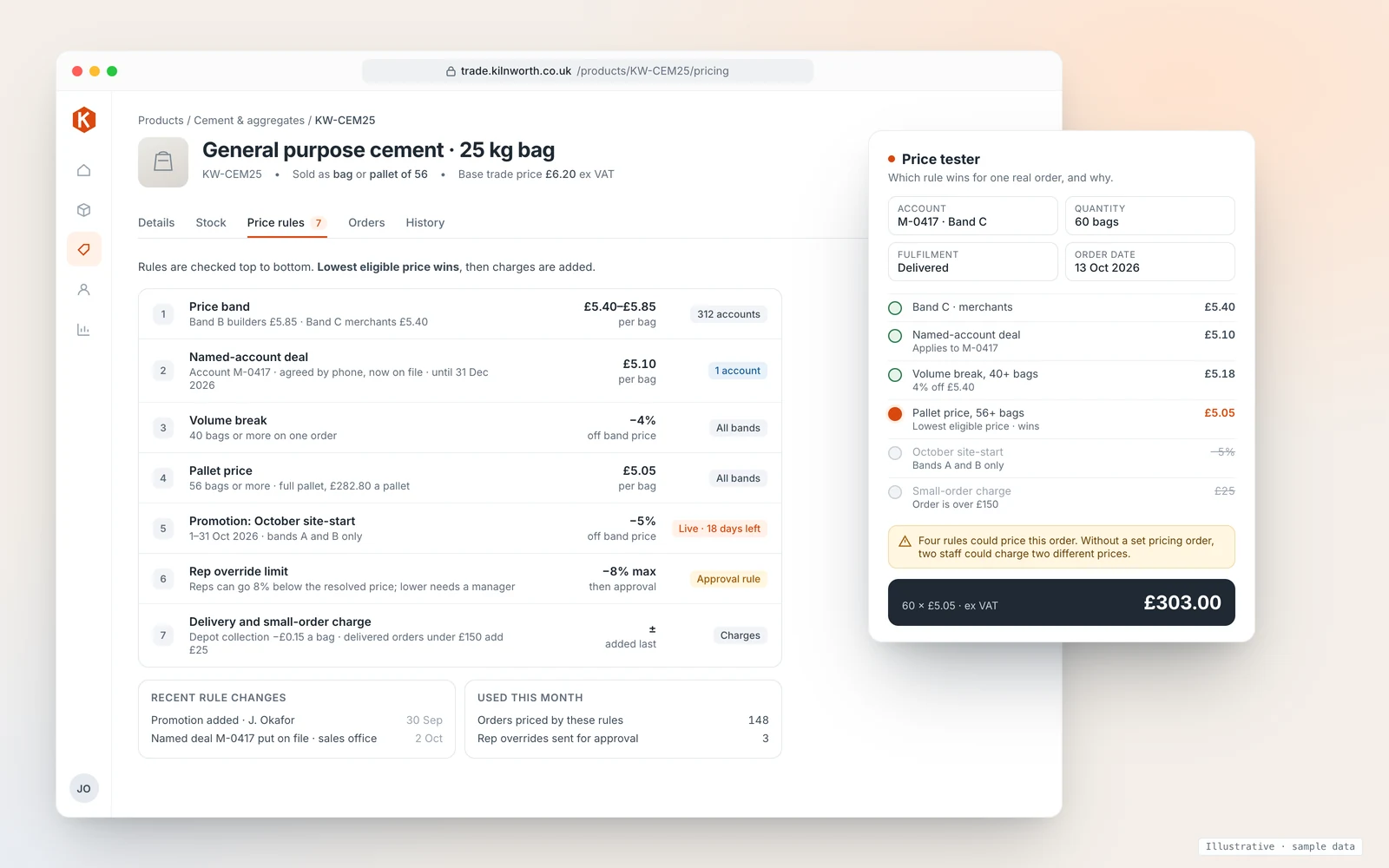
The question we hear most is "what does a portal cost?", and the honest answer starts with another question: how many different prices can one product have in your business today? Buyers tend to count products and customers. The time actually goes on the pricing rules nobody wrote down: the special deal one account has had for years, the pack-size discount a rep agreed by phone. Write those rules down before you get any quote, ours included, and the quotes you collect will finally be comparable. Try it on one product below.
— Avi Singh, Founder
Count the prices on one product
Pick your best-selling product. Tap every way its price can change today. It takes about twenty seconds, and the count tells you more about your portal cost than your product or customer numbers.
Your answers go into the message for you. Add your name and email, and we reply by email with which side of the worksheet below you belong on. Nothing is sent until you press send.
This runs in your browser. Nothing you tap is sent anywhere unless you choose to send it.
Where subscription prices step up
Most published portal pricing looks cheap at the entry tier. The cost question is what makes you leave that tier. We checked three vendors' own pricing pages on 13 October 2026; these are the triggers each one prices on.
| Vendor (published plan) | Entry point | What pushes you up |
|---|---|---|
| Orderspace | $65 a month ex VAT: up to 3 admin users, no sales reps | Sales reps. Up to 3 reps means the $95 plan, up to 10 the $125 plan, up to 20 the $185 plan. Orders, customers and products are unlimited on every plan |
| B2B Wave | Entry plans: 10 users, 20 customer price lists, 20,000 products | Price lists and users beyond those caps, priced on request as add-ons or a higher tier |
| Shopify B2B (non-Plus) | Company profiles for wholesale buyers, payment terms, up to 3 custom catalogues on Basic, Grow and Advanced | More than three customer catalogues, direct catalogue assignment, partial payments or deposits: these stay on Plus |
Two things follow from that table. First, find your own trigger before you compare headline prices. A wholesaler with four reps and one price list sits in a different tier on Orderspace than one with no reps and fifty price lists on B2B Wave. Second, look hard at the top step. Shopify's Plus pricing page sells Plus on one- or three-year terms, moves more complex businesses to a variable platform fee based on revenue, and adds a 0.20% charge per transaction when you use a third-party payment provider. That is a different kind of bill from a monthly plan, and it should be priced as one.
The accounting link now has its own price
Most portal cost pages skip the connection to your accounts, and since March 2026 that leaves a gap, at least for Xero users. Xero's developer pricing moved app developers onto tiers from 2 March 2026:
| Xero developer tier | Monthly fee (AUD, ex tax) | Connected organisations |
|---|---|---|
| Starter | No charge | Up to 5 |
| Core | $35 | Up to 50 |
| Plus | $245 | Up to 1,000 |
| Advanced | $1,445 | Up to 10,000 |
For a subscription vendor, that fee is part of their own costs, and it may show up in your plan price later. For a portal built only for you, there are two routes. A standard app connected to one organisation sits inside the free Starter cap, which also limits API calls to 1,000 a day per organisation. Alternatively, a Xero Custom Connection links one app to one organisation, is available in the UK, US, Australia and New Zealand, and needs an extra monthly subscription that your own Xero organisation buys. Neither route is expensive. The point is to know which one your supplier plans to use and whose card pays for it.
Other accounting systems have their own developer terms. Whichever you use, ask the question in the same words: "which API, which plan, and who pays?"
What sets a build quote: five things to count
If you are getting a portal built, the quote is set by your trading rules far more than by the number of screens. Count these five before any call. They are the same questions we ask in a fit check.
- Distinct prices per product. Count price lists, customer-specific deals, volume breaks, promotional prices and pack-size pricing. One trade price list is a small job. Fifty customer deals with exceptions is a pricing engine.
- Places stock lives. One warehouse, or several? Do you track batches, expiry dates or duty-paid status? Every extra stock dimension touches ordering, picking and invoicing.
- Systems the portal must talk to. Accounting, courier, ERP, card payments, email. For each one, find out whether it has a documented API. A system without one is the biggest single multiplier on any integration quote.
- Data that has to come across. Products, pack sizes, customers, credit limits, price lists and at least a year of order history, so customers can reorder on day one. Untidy product codes are cleaned once, and someone pays for that time.
- People who approve things. New trade accounts, orders over a credit limit, price overrides. Each approval step is a screen, a rule and a notification.
A build that scores low on all five is quick. A build that scores high on two or three is where quotes diverge between suppliers, and where you should ask each one how they priced that line.
A three-year worksheet
Fill in both columns for your business. Use a three-year total because most build costs fall in year one and most subscription costs are spread evenly, so a one-year comparison flatters the subscription and a five-year one flatters the build.
| Cost line | Subscription portal | Portal built for you |
|---|---|---|
| Setup or build | Onboarding fee, if any | Fixed build quote |
| Data import and clean-up | Usually your own staff time | Quoted line, or your staff time |
| Monthly platform or hosting | Plan price × 36, at the tier your reps and price lists need | Hosting × 36 |
| Tier step-ups | The tier you will need in year two or three | Not applicable |
| Accounting and courier links | Add-on or app fees | Developer and connection fees, as above |
| Payment fees | Processor fees, plus any platform charge | Processor fees |
| Support | Included or tiered | Support line, quoted separately |
| Changes | What the vendor will and won't change | Price of a typical change, asked up front |
| Leaving | Export formats available | You own code and data |
A worked line, from published prices only. A wholesaler with eight sales reps on Orderspace needs the $125 plan. That is $4,500 over 36 months, excluding VAT, before any add-ons. If the sales team grows past ten reps in year two, the remaining months move to $185. Put the same discipline into the build column: the one-off quote, plus 36 months of hosting and support, plus the cost of the two or three changes you can already see coming.
If the subscription column wins, take the subscription. We say that on calls too. A build earns its place when the step-ups in the left column keep coming, or when the rules in your business can't be expressed in a vendor's settings at all.
If you sell in the UK: two rules that change the scope
Making Tax Digital links. HMRC's VAT Notice 700/22 says data moving between the software that makes up your VAT records must travel by digital link, such as an API or a CSV or XML import and export. Copy-and-paste and retyping don't count. A portal whose orders someone rekeys into the accounts saves less than it looks on paper, and the import or API line belongs in every quote you compare.
E-invoicing from April 2029. The government's consultation response on electronic invoicing says all VAT invoices will have to be issued as e-invoices from 2029, and HMRC's Transformation Roadmap update puts the start at April 2029. The government has also announced that Peppol will be the core network for UK e-invoicing. The detailed implementation roadmap is due at Budget 2026. Don't pay for an e-invoicing module now. Do ask a supplier whether invoices are generated as structured data inside their system, because that is what makes a later switch a configuration job rather than a rebuild. Until then, a full VAT invoice still has to show what VAT Notice 700/21 lists, whichever portal raises it.
How we price a portal
We don't publish a portal price list because the five counts above move the number too far for one figure to be honest. Instead, you get a fixed quote after a 20-minute walkthrough, with the full cost known before any work starts. Portals are quoted on their own, outside the range we publish for single automation jobs. Run costs such as hosting and paid connections are listed as separate lines.
We don't start from a blank page either. A trade portal we built covers sales and warehousing and is used every day by a UK wholesaler, so the ordering, stock and pricing basics already exist. The quote covers fitting them to your rules. The route is the same each time: walkthrough, a fit check of your products, customers, price lists and warehouses, set-up and import on a fixed plan and timeline, then training and close support through the first weeks of live orders. We connect accounting systems such as Xero, Sage and QuickBooks through their official APIs, host in the region you need, and you own the code and data, with CSV export any time. Our development team is in India.
For what a portal does day to day and how it compares with Shopify B2B, see our B2B ordering portal page. If your reps take orders on the road, the sales rep ordering app uses the same prices and stock. For the cost of automating one job, such as emailed purchase orders, see how much AI automation costs.
Book a 20-minute walkthrough or send us your counts for the five items above. We'll tell you which column of the worksheet you belong in.
Sources
- HMRC, VAT Notice 700/22: Making Tax Digital for VAT, section 3.2.1 (digital links)
- HM Treasury and HMRC, Promoting electronic invoicing across UK businesses and the public sector: consultation response (updated 26 November 2025)
- HMRC, Record keeping (VAT Notice 700/21)
- HMRC, HMRC Transformation Roadmap: update 2026 (updated 27 July 2026), section 4.2
- HM Treasury, Tax update 2026: simplification, modernisation and fairness (updated 23 June 2026): Peppol as the core interoperability network
- Orderspace, Pricing (accessed 13 October 2026)
- B2B Wave, Pricing (accessed 13 October 2026)
- Shopify, B2B for all (2 April 2026) and Shopify Plus pricing (accessed 13 October 2026)
- Xero Developer, Pricing and Custom Connections (accessed 13 October 2026)
Last reviewed 13 October 2026. Vendor prices are list prices from their own pages, exclude tax and change without notice; check each page on the day you budget. This guide isn't tax advice.