

For food and drink wholesalers and distributors
Software for food and drink distributors that knows which batch went where
Trade ordering, batch and expiry control and recall look-ups in one system, built around how you already pick, deliver and invoice. We quote a fixed price before work starts.
In short: software for food and drink distributors has to do three jobs that a generic ordering tool doesn't: hold stock by batch and expiry date, record which batch went to which customer on which van, and invoice each line at the right tax rate. Get those right and recalls, short-dated stock and audits stop being week-long scrambles. We build systems that do this around your existing products, customers and warehouses.
From our side
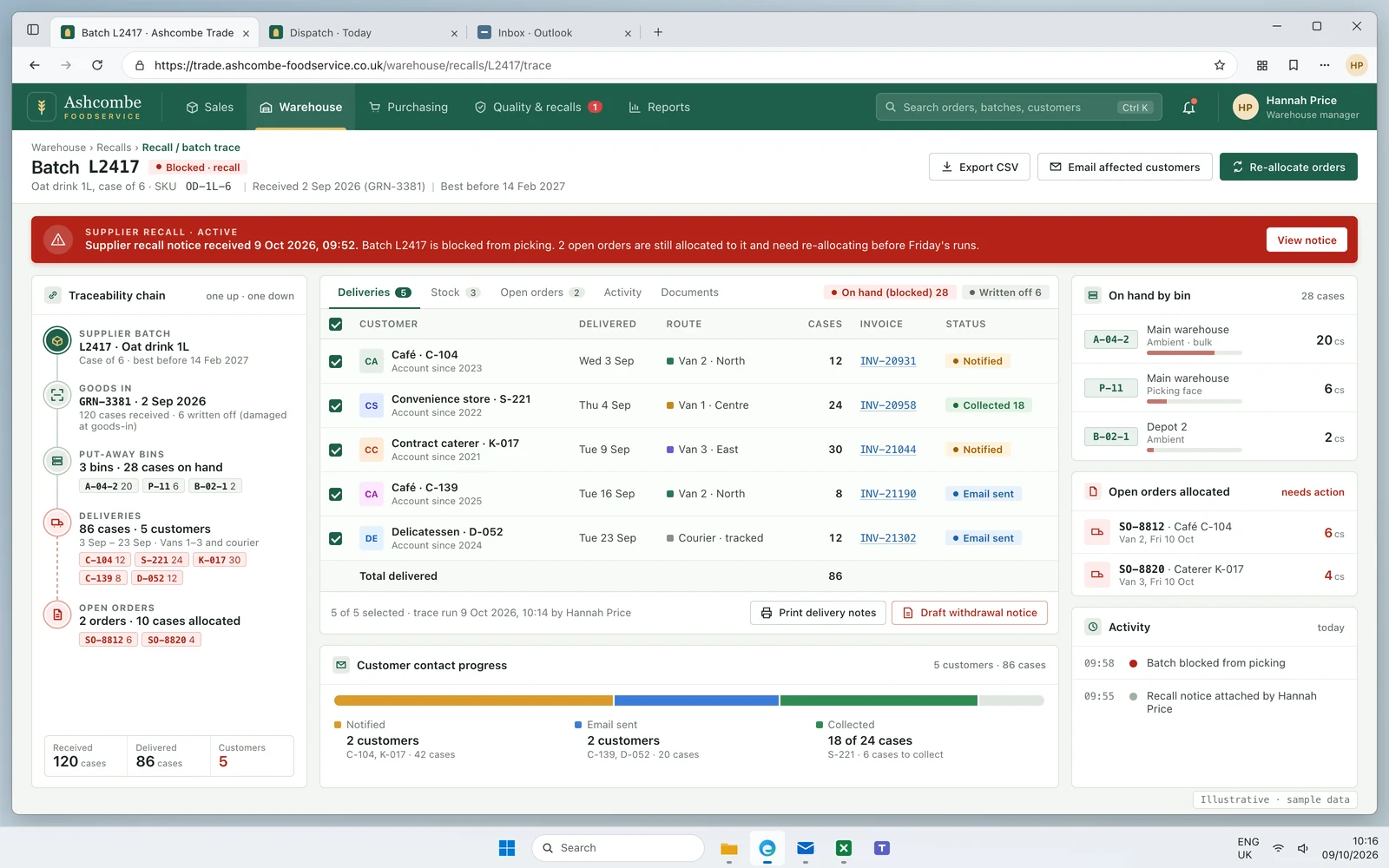
Before we talk about features, I ask distributors to run the recall test below on one product they sold last month. The batch number is usually written down at goods-in. The trail goes cold later, at picking and loading the van, because nobody is asked to confirm which batch went on which order. Fix that one step and most of the rest of traceability follows, and it's the step I'd test hardest in any demo, ours included.
The ten-minute recall test
Before you look at any software, including ours, run this test on your current setup. Pick a product you sold last month and pretend your supplier has just recalled one batch of it.
| Question | What good looks like | Where it usually breaks |
|---|---|---|
| Which customers received batch L2417? | A list in under a minute, with delivery dates and quantities | Batch was written on the goods-in sheet but never linked to picking |
| How much of that batch is still on our shelves, and where? | Quantity per warehouse and bin | Stock is held per product, not per batch |
| Which open orders would pick it next? | Orders flagged before they are picked | Pickers choose by eye from the front of the shelf |
| Can we tell those customers today? | Contact list exported from the same screen | Contacts live in a separate spreadsheet or phone |
| Can we prove what we did? | A dated record of the withdrawal and messages sent | Evidence is scattered across email |
The Food Standards Agency sets out the legal minimum as one step back and one step forward: you must be able to identify your suppliers and the food businesses you supply, with names, addresses, type and quantity of product and dates, and keep those records up to date and available for inspection (FSA, Managing food safety). If you find food you handled is unsafe, you must withdraw or recall it immediately and tell your local authority or port health authority (FSA, food incidents, withdrawals and recalls).
Notice that batch numbers are optional in that guidance. That is exactly why so many distributors can't answer the first question in the table: the law didn't force the link, so the system never made it. The price is paid on the day of a recall, when the only safe answer is "everyone who bought it".
What we build for food and drink distribution
We don't sell a boxed package. We build the parts you are missing and connect them to what already works, starting from a trade portal that already runs sales and warehousing every day for a wholesaler in another tightly regulated trade.
Goods-in with batch and date captured once. Scan or type the batch and the use-by or best-before date at receipt. From then on, every movement carries it: put-away, picking, transfers between warehouses, returns.
First-expiry-first-out picking. The pick list tells the picker which batch to take, rather than leaving it to whoever is on shift. Use-by dates relate to safety and best-before dates to quality (GOV.UK, best before and use-by dates), so the two are handled differently: use-by stock is blocked from picking once its date passes, while best-before stock can be flagged for a clearance price list instead of written off.
Dispatch that records the batch. When the van is loaded, the order lines are confirmed against the batches actually picked. That one step is what makes the recall test pass.
A trade ordering portal. Customers log in, see their own prices, pack sizes and delivery days, and reorder from last week. If customers already order by email or message, the same order can arrive through WhatsApp ordering or be read from emailed purchase orders by AI order processing, and still land in one queue for a person to approve. Read more about the portal itself on our B2B ordering portal page.
Product data that carries allergens. Food law names 14 allergens that must be declared (FSA allergen guidance for food businesses). Caterers and shops who sell on to the public at a distance must give that information before the sale and again at delivery. If your product records hold the 14 fields and you show them in the portal, your customers can meet their duty without phoning you.
Integrations. Orders become invoices in Xero, Sage, QuickBooks or another accounting system through its official API, and dispatch can connect to the courier or routing tool you already use.
Tax on food invoices: one rate per line, not per order
For UK distributors, a single delivery to a café or corner shop often mixes zero-rated and standard-rated goods. HMRC's rule is that most food is zero-rated, but confectionery, potato crisps and similar puffed or salted snacks, carbonated drinks, cordials and squashes, alcoholic drinks and ice cream are standard-rated (HMRC, VAT Notice 701/14). Biscuits covered or partly covered in chocolate are standard-rated, for example, while chocolate chip biscuits with the chips baked into the dough are zero-rated. A system that applies VAT per order, or relies on staff to remember, gets these wrong quietly for months.
We put a VAT code on every product at import, check the list with you and your accountant before go-live, and let each invoice line carry its own rate. Outside the UK, the same approach applies to GST or sales tax bands.
If you sell or buy alcohol
A UK business that sells alcohol to other businesses for onward sale needs approval under HMRC's Alcohol Wholesaler Registration Scheme, and trade buyers are expected to check that approval before trading and to repeat the check (HMRC, AWRS guidance; HMRC manual AWRS90200). HMRC doesn't set how often. In practice that means two small features: your approval number printed on invoices and statements so customers can find it, and, on the buying side, a dated record of each check you make on your own alcohol suppliers, with a reminder when the next one is due.
Exporting to the United States
If you ship foods on the FDA's Food Traceability List for US consumption, the FDA rule applies to foreign firms too. It asks for key data elements linked to a traceability lot code and, on request, an electronic sortable spreadsheet within 24 hours. The FDA has proposed moving compliance to 20 July 2028 and says it will follow Congress's direction not to enforce before that date (FDA, Food Traceability Rule). If your dispatch already records batch per order line, producing that spreadsheet is an export, not a project.
Choosing between a package and a build
| A food distribution package is likely enough if… | A build around your process fits better if… |
|---|---|
| You run one warehouse and one price list | You run several price lists, depots or delivery rounds |
| The package's batch and expiry rules match yours | You need your own rules, such as blocking use-by stock or clearance lists |
| You are happy on its accounting connectors | You need a specific accounting, routing or EDI link |
| Your customers will use its ordering app | Orders arrive by email, WhatsApp and phone and you want one queue |
Our honest view: several packages already handle batch tracking well, so try them first if they fit. We are a better fit when the gaps are in your process, not in a feature list.
Who builds it and how we start
Coded Idea is a software company founded in 2020. The development team is based in India, and we have no UK office. We have delivered more than 500 projects across web, app and automation work.
Every project starts with a 20-minute walkthrough. We then check a sample of your products, customers, price lists and warehouses, agree a fixed plan and timeline for set-up and data import, and support your team closely through the first weeks of live orders. You get a fixed quote with the full cost before work starts. Your code and data stay yours, hosted in the region you choose and exportable to CSV.
Reps who take orders in shops can use a sales rep ordering app on the same prices and batches.
Book a 20-minute walkthrough and bring last month's dispatch records for one product: we'll run the recall test on them with you. Prefer to write first? Use the enquiry form.