

Guide + policy checker · Trade terms
Wholesale minimum order quantity (MOQ) policy template: five rules to set, and the wording to put on your price list
On this page8 sections
Short answer: a wholesale minimum order quantity (MOQ) policy has to answer five separate questions, not one: what unit you sell in (each, pack, case, pallet), the minimum per product line, the minimum for the whole order (in units or in money), what happens below the minimum (refuse, surcharge or allow with a delivery charge), and who is allowed an exception. Most free templates give one line such as "minimum order £100" and stop there, which leaves your office to decide the other four on the phone, customer by customer. Use the checker below to see which of the five your policy leaves open, then copy the wording underneath onto your price list and trade terms.
Check your MOQ policy: which disputes will it cause?
Tick each rule your policy states in writing today, on the price list, in your trade terms or on your order form. The meter shows how much is settled, and the list shows the argument each gap starts.
The wording is the five rules as a block you can paste into trade terms or the top of a price list, with blanks for your numbers. The CSV is a product table with a column for each rule, for Excel or Google Sheets.
Your ticks and the missing rules go into the message for you. Add your name and email, and we reply by email with what we would settle first. Nothing is sent until you press send.
This runs in your browser. Nothing you tick is sent anywhere unless you choose to send it.
The five rules, with wording you can copy
| Rule | What to decide | Wording to adapt |
|---|---|---|
| 1. Unit of sale | Each, pack, case or pallet, per product | "Every product is sold in the unit shown beside it on the price list. We do not split packs." |
| 2. Line minimum | The least of one product you will send | "Where a line has a minimum it is shown on the price list, in whole units of sale." |
| 3. Order minimum | Units or money, and whether VAT and delivery count | "The minimum order is ____ ex VAT, before delivery." |
| 4. Below the minimum | Refuse, surcharge or delivery charge | "Orders below the minimum are accepted with a ____ delivery charge." |
| 5. Exceptions | Who may waive a rule, and how it is recorded | "Only the sales manager can approve an exception; the reason is noted on the order." |
Two things make these hold. First, decide which of "units" and "money" you mean for each rule and say so. A line minimum counts units; an order minimum usually counts pounds. Mixing them is the most common cause of the "does that include VAT?" call. Second, keep the minimum separate from the free-delivery threshold. They are two numbers with two jobs: the first decides whether you take the order, the second decides who pays for the van. Customers who see one number assume it is the other.
What the policy does not need: a paragraph of reasons. Customers accept a rule they can find quickly; they argue with one they have to hunt for. Put the rule next to the unit of sale on your wholesale price list, which is where they look first, and repeat it in the terms they agree when you open the account.
What a minimum looks like when the basket enforces it
A written policy still depends on your office noticing a breach after the order arrives. The change that removes the argument is showing the rule while the customer builds the order, with the fix one tap away.
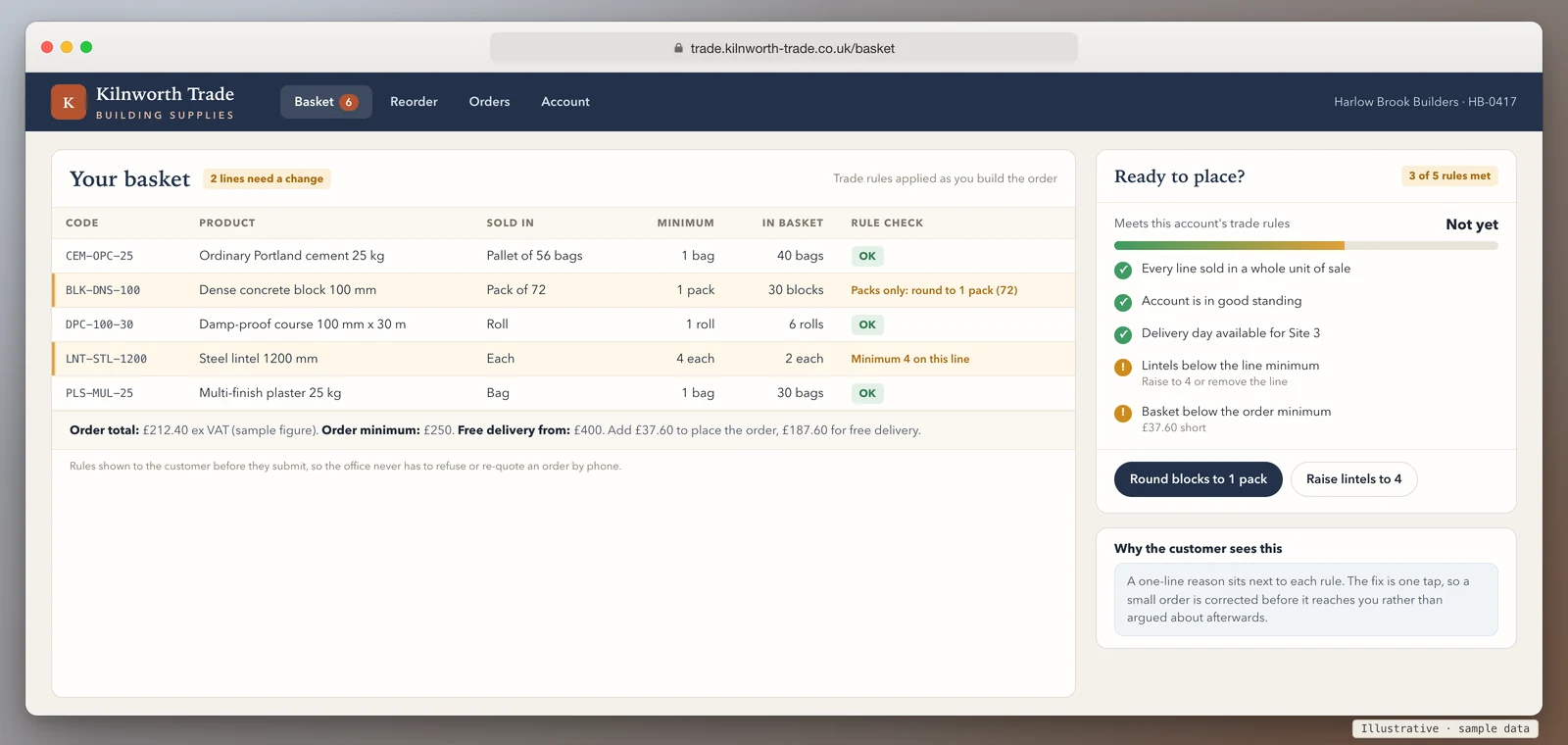
That is the difference between a form and an ordering portal. A paper or PDF form cannot check anything. A web form can require a unit of sale, but does not know the customer's account or their usual quantities. A portal knows both, so the rule can differ by account (rule 5) without anyone remembering it. Our guide to the wholesale order form covers the fields that make an order complete; this guide covers the rules the quantities have to satisfy.
Common ways MOQ policies go wrong
- One number for everything. "Minimum order £100" says nothing about a line that is sold by the pallet, or a new account's first order.
- Exceptions by whoever answers the phone. The customer learns to ring until someone says yes. Name the role that can waive a rule, and record the reason on the order.
- The price list, terms and form disagree. The customer quotes the friendliest version. Keep all three the same, and change them together.
- A minimum that blocks your best customers. A rule that suits a new account can annoy a customer who orders weekly. Set the rule per account type, not once for everyone.
- Counting the wrong thing. If the minimum is in pounds but prices change, the unit count behind it moves too. Check the figure whenever you change prices.
A short legal note on quantities
A minimum order rule is a commercial term you are free to set, and this guide is not legal advice. But quantity does have a legal side once an order is placed. The Sale of Goods Act 1979, section 30, covers delivering the wrong quantity: section 30(1) says that if you deliver less than you contracted to supply, the buyer may reject the goods, and the Act limits that right where the shortfall is slight, with the burden of showing it on the seller (section 30(2A) and (2B)). In practice, that is a reason to keep the quantity on the order, the delivery note and the invoice the same, and to record any part delivery as agreed.
Where your minimums sit in standard written terms you send to every customer, section 3 of the Unfair Contract Terms Act 1977 applies to terms of that kind where one party deals on the other's written standard terms. It is aimed at terms that exclude or restrict liability, so a plain minimum is not its target, but a clause that lets you deliver something substantially different from what was ordered has to be reasonable. Show your terms to an adviser if they go further than a minimum.
Payment on a small order follows the same rules as any other: if no date is agreed, GOV.UK's guidance on late commercial payments says payment is late 30 days after the customer receives the invoice or the goods, whichever is later. Our trade account application form guide covers where to agree those terms before the first order.
When a policy on paper stops being enough
These are the signs we look for when a wholesaler shows us how minimums work today:
- Small orders arrive and someone has to ring the customer. Every call is a refused or re-quoted order that could have been fixed at the basket.
- Exceptions are remembered, not recorded. Nobody can say why one customer got a lower minimum.
- Split packs are shipped "just this once". Then it becomes expected.
- Orders keep arriving as emails and photos. Our AI order processing page covers reading them into your system, with the rule check applied afterwards.
A trade ordering portal applies the rules at the basket: unit of sale, line minimum, order minimum and the per-account exception. We build portals like that; one we built covers sales and warehousing and is used every day by a UK wholesaler. We connect to accounting systems such as Xero, Sage and QuickBooks through their official APIs, and you own the code and data, with CSV export any time. How it works for wholesalers is on our B2B ordering portal page, and our distributor order portal guide covers what to check before you buy.
How we'd approach yours
We start with a 20-minute walkthrough of how orders reach you today and where small ones cause work, then a fit check of your products, customers, price lists and warehouses, and only then a fixed plan and timeline. You get a fixed quote with the full cost known before work starts. If a clear written policy is all you need, we'll say so.
Book a 20-minute walkthrough or send us your minimum order rules and we'll mark the gaps that cause calls.
Sources
- legislation.gov.uk, Sale of Goods Act 1979, section 30: delivery of wrong quantity (section 30(1), (2A) and (2B))
- legislation.gov.uk, Unfair Contract Terms Act 1977, section 3: where one party deals on the other's written standard terms
- GOV.UK, Late commercial payments: charging interest and debt recovery
Last reviewed 6 November 2026. This guide explains what the official sources say; it isn't legal advice. Check your own terms and contracts with an adviser if you're unsure.