

Guide + gap check · UK VAT invoices
E-invoicing in the UK: what the 2029 roadmap says and what your invoicing must do
On this page6 sections
Short answer: from 1 April 2029, VAT-registered businesses in the UK must be able to issue and receive VAT invoices as e-invoices: structured, machine-readable data, not PDFs. The government published its implementation roadmap on 28 October 2026 with Budget 2026, and the roadmap itself is the source for everything on this page. Peppol is the core network, you connect through your software provider, and the detailed rules arrive between October 2027 and April 2028. Nothing has to be bought today. What you can do now is find out how many of your invoices are only a PDF, and use the check below to see where your gaps are.
Check your invoicing: tick what's true today
Each tick is a gap between how you invoice now and what the roadmap describes. The more you tick, the longer your list of questions for your software supplier. This runs in your browser and nothing is sent unless you press the button at the end.
Your ticks go into the message for you. Add your name and email, and we reply with what we'd check first. Nothing is sent until you press send.
This runs in your browser. Nothing you tick is sent anywhere unless you choose to send it.
What the roadmap confirms
The roadmap is specific on scope and dates, and says very little about detail that hasn't been decided. Here is what it states, in plain terms.
| Question | What the gov.uk roadmap says |
|---|---|
| Start date | 1 April 2029 |
| Who | VAT-registered persons, including sole traders, partnerships, charities and public sector bodies |
| Which invoices | Taxable supplies between VAT-registered parties where a VAT invoice is required |
| Not covered | Sales to consumers, supplies to non-VAT-registered businesses, cross-border transactions |
| Format | Structured data only. PDFs, Word files, JPEGs, HTML and emailed images are excluded |
| Network | Peppol is the core interoperability framework |
| Connecting | Usually through a certified Access Point, supplied by your software provider |
| Exemptions | Limited and tightly defined, following Making Tax Digital for VAT criteria; details by April 2028 |
| Thresholds | None mentioned |
Two points catch people out. First, the rule is about receiving as well as issuing. A business that only ever sends PDFs but takes supplier invoices by email still has work to do. Second, it applies to VAT-registered businesses of any size. The roadmap mentions no turnover threshold, so a small trade customer who is VAT-registered is in scope on the receiving side too.
The dates that matter
The roadmap's timeline is long, and most of it is about when the detail lands. Nothing in it asks a business to change a system before 2027 or 2028.
| When | What happens, per the roadmap |
|---|---|
| Spring 2027 | Public technical consultations on UK standards and Access Point certification. Primary legislation expected via Finance Bill 2026, subject to Parliament |
| Autumn 2027 | Guidance on legacy and EDI systems |
| End of 2027 | Guidance for specific taxpayer groups |
| October 2027 to April 2028 | Final requirements published: scope, standards, business identifiers, obligations |
| By April 2028 | Digital exclusion exemption details and updated VAT guidance. Requirements then not expected to change, unless stakeholder feedback makes it necessary |
| Summer 2028 | Readiness testing with software providers |
| 1 April 2029 | Mandate takes effect; software providers expected to have completed UK Peppol Authority accreditation |
The practical reading: you have until roughly April 2028 to find out what you need, and a year after that to have it working. Spending on an e-invoicing module before the final requirements exist risks buying something that has to be redone.
What it means for your systems
The roadmap puts the technical weight on software providers, who must meet UK Peppol Authority requirements and be certified. For a wholesaler, three things sit on your side of that line.
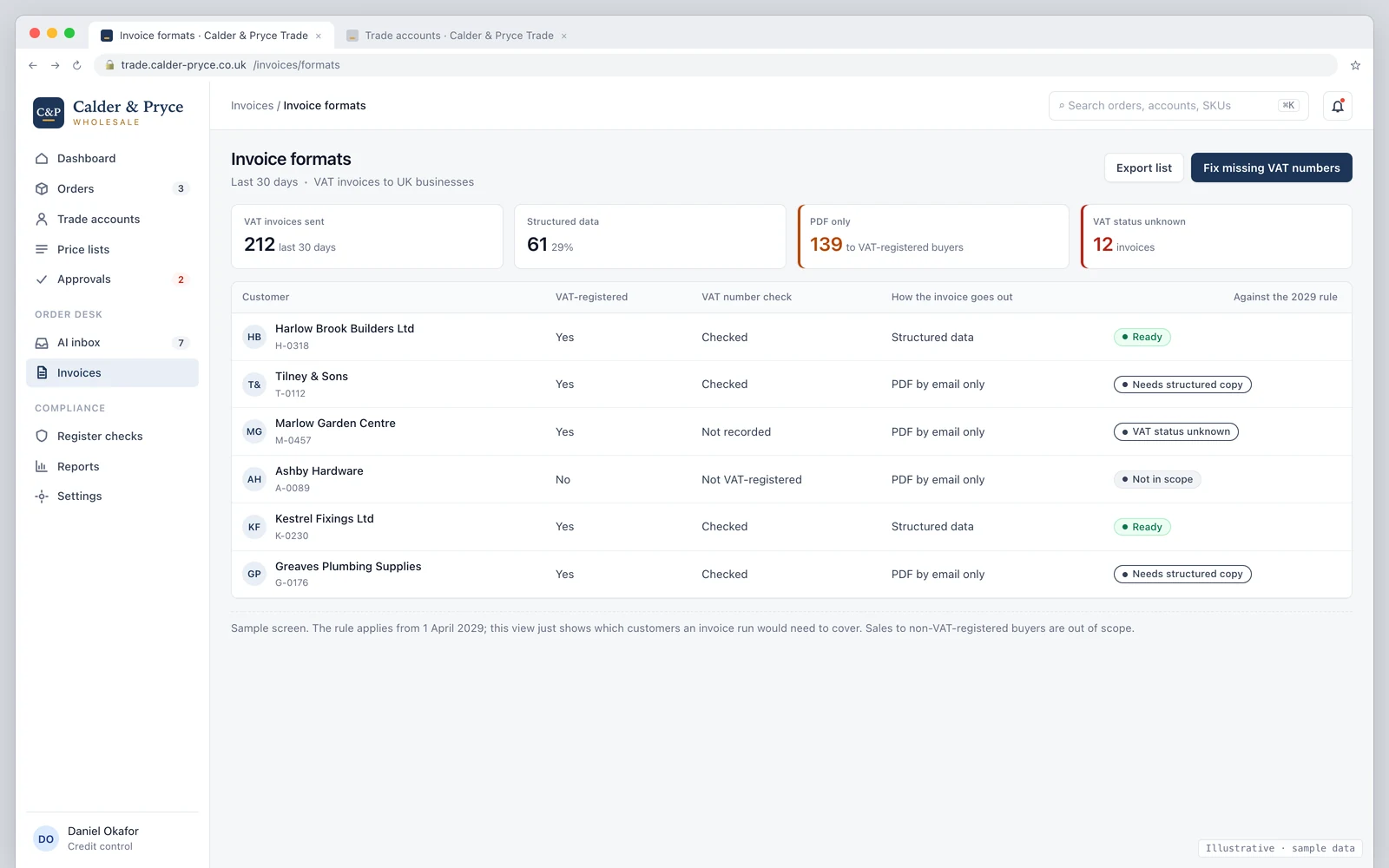
- Invoices as data, not documents. If the invoice is created inside your system from the order, the structured version is a different output of the same record. If it is typed in Word or built in a spreadsheet, there is no record to export. This is where most of the work is.
- A checked VAT number per customer. Scope depends on whether the buyer is VAT-registered. The free Check a UK VAT number service confirms a number and the registered name. Storing the result on the account is the cheap fix.
- Receiving. Someone needs to know where incoming structured invoices will land, and whether the purchase ledger can take them without re-keying.
None of this changes what a VAT invoice must show. Until 2029, the content rules in VAT Notice 700/21 still apply to every invoice, whatever format it is in. Our guide to what to look for in a B2B ordering portal covers the question to ask a supplier today: is the invoice generated as structured data inside the system?
What is still undecided
Plenty, and it is worth knowing before you act on a vendor's confident advice.
- Business identifiers. Every user must register an identifier as part of their Peppol identity. Which identifiers are approved will be decided between October 2027 and April 2028.
- UK-specific rules. The roadmap says UK Peppol Authority Specific Requirements may add rules on identifiers, security, reporting and service levels, and are still under consideration.
- Penalties. Based on the existing VAT invoicing penalties framework, with compliance details due by April 2028. No e-invoicing amounts are published.
- Digital reporting. A consultation launched at Budget 2026 explores using e-invoice data for tax administration. The roadmap says no decisions have been taken.
If a page quotes a penalty figure or a reporting date for UK e-invoicing today, it has no official source behind it.
Where we come in
We don't sell an e-invoicing product and the UK isn't ready for one to exist yet. What we do is build the parts of the order-to-invoice path that your accounting software doesn't cover: portals, order capture, and the integrations through official APIs that feed Xero, Sage or QuickBooks. Where that work is needed, it makes the later switch to structured invoices a configuration job rather than a rebuild. Where your software supplier already covers it, we'll say so.