

Guide · UAE e-invoicing
UAE e-invoicing penalties: the fines in Cabinet Decision No. 173 of 2026
On this page8 sections
Short answer: UAE e-invoicing penalties are now set by Cabinet Decision No. 173 of 2026, in force since 15 October 2026. Not implementing e-invoicing, including not appointing an Accredited Service Provider (ASP), costs AED 5,000 and then AED 5,000 a month while it continues, capped at AED 50,000 in any 12 consecutive months. Each e-invoice or e-credit note not issued and sent through the system costs AED 100, up to AED 5,000 per calendar month for each. Not telling your ASP about a change to your FTA-registered details costs AED 250 a day, up to AED 5,000 a month. Voluntary adopters are outside the decision.
Most of what has been written about the new fines comes from the Ministry of Finance's 30 October 2026 announcement, which gives the headline amounts but not the decision number, the dates or the full table. We read the decision itself on the UAE's official legislation portal, uaelegislation.gov.ae, where it is published in Arabic with its annexed penalty table. The English wording below is our translation. Where a row could be read two ways, we say so rather than pick one.
The decision at a glance
| Cabinet Decision No. 173 of 2026 | |
|---|---|
| Subject | Violations and administrative penalties for breaking the rules of the e-invoicing system |
| Issued | 6 October 2026 |
| Published | Official Gazette issue 833, 14 October 2026 |
| In force | 15 October 2026 (the day after publication, Article 5) |
| Replaces | Cabinet Decision No. 106 of 2025, repealed in full (Article 4) |
| Who it covers | Issuers and recipients who must use the e-invoicing system |
| Who it excludes | Anyone using e-invoicing voluntarily (Article 2(2)) |
| Double penalties | One penalty only where the same person is issuer, recipient or both for the same violation (Article 3(2)) |
The decision doesn't set dates for who must do what. Those come from Ministerial Decision No. 244 of 2025, as amended by Ministerial Decision No. 66 of 2026: businesses with revenue of AED 50 million or more had to appoint an ASP by 30 October 2026 and go live on 1 January 2027; smaller businesses appoint by 31 March 2027 and go live on 1 July 2027; government entities go live on 1 October 2027. Our ERP integration guide covers those phases in detail.
The full penalty table
The annex has four rows. Row 1 has two parts that share one fine.
| Row | Violation (our translation) | Administrative penalty |
|---|---|---|
| 1(a) | The issuer or recipient doesn't apply the e-invoicing system as Ministerial Decision No. 244 of 2025 (and its amendments) requires, including not appointing an accredited service provider | AED 5,000 the first time (a), (b) or both are committed, then AED 5,000 for each month or part month the non-compliance continues. Total for row 1 capped at AED 50,000 in any 12 consecutive months |
| 1(b) | After applying the system, the recipient doesn't keep meeting its obligations as a recipient under Ministerial Decision No. 243 of 2025 (and its amendments) | Shares the row 1 fine and cap above |
| 2 | The issuer doesn't issue and send an e-invoice to the recipient through the e-invoicing system | AED 100 per e-invoice, up to AED 5,000 per calendar month |
| 3 | The issuer doesn't issue and send an e-credit note to the recipient through the e-invoicing system | AED 100 per e-credit note, up to AED 5,000 per calendar month |
| 4 | The issuer or recipient doesn't notify its appointed ASP of a change to the data registered with the Federal Tax Authority | AED 250 for each day of delay or part day, up to AED 5,000 per calendar month |
Three details matter when you read it:
- The AED 50,000 cap belongs to row 1 only. Rows 2, 3 and 4 have monthly caps, and the decision sets no yearly cap for them. A business that keeps failing rows 2 and 3 can reach AED 10,000 a month from those two rows alone.
- Row 1(b) is the purchase side. Being a recipient is an obligation too. A business that has appointed an ASP but doesn't receive and handle supplier e-invoices as Ministerial Decision No. 243 requires falls into row 1, not a smaller row.
- "First time, then each month." We read row 1 as AED 5,000 when the violation is first committed and a further AED 5,000 for every month or part month it carries on, so ten charges reach the cap. The text doesn't say how the FTA counts the first month in practice. If you're already in row 1, ask the FTA or your tax adviser rather than plan around our reading.
What changed from Cabinet Decision No. 106 of 2025
Most coverage says only that the fines were "revised". Here is each row against the decision it replaced, using the Ministry of Finance's English text of Decision No. 106 of 2025.
| Failure | Old: Decision No. 106 of 2025 | New: Decision No. 173 of 2026 |
|---|---|---|
| Not implementing e-invoicing / not appointing an ASP | AED 5,000 per month or part month, no cap | AED 5,000, then AED 5,000 per month or part month, capped at AED 50,000 per 12 months; recipient obligations added to the same row |
| E-invoice not issued or sent | AED 100 each, up to AED 5,000 a month | Same amounts |
| E-credit note not issued or sent | AED 100 each, up to AED 5,000 a month | Same amounts |
| Not notifying a system failure | AED 1,000 per day | Removed (the duty itself was repealed by Ministerial Decision No. 197 of 2026) |
| Not telling the ASP about changes to registered data | AED 1,000 per day | AED 250 per day, capped at AED 5,000 a month |
| Issuer and recipient are the same person | No rule | One penalty only for the same violation |
| Voluntary adopters | Outside the penalty decisions under Ministerial Decision No. 243 | Excluded in the decision itself |
So the new decision is lighter for most failures, but the invoice and credit-note rows didn't change at all. Those are the rows a working system breaks most often, because they're counted per document.
Work out your exposure
Enter what applies to you. The calculator uses only the amounts and caps in the decision's table, and it treats a rejected invoice that is never resent as one that wasn't issued and sent. It's an estimate to plan with, not a penalty assessment.
Your figures go into the message for you. Add your name and email, and we reply by email with where the gaps usually sit in the system. Nothing is sent until you press send.
This runs in your browser. Nothing you enter is sent anywhere unless you choose to send it.
What your system should record for each row
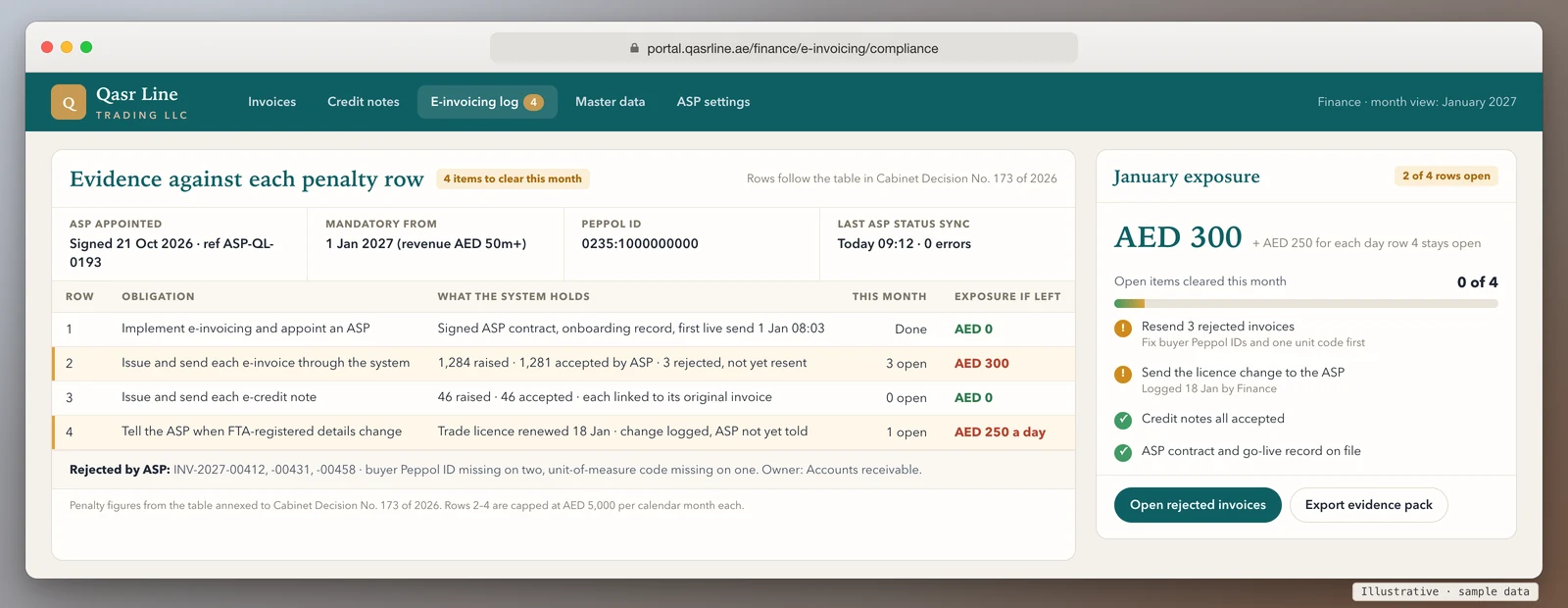
A penalty table tells you what the FTA can charge. It doesn't tell you how you'd show you complied. For each row there is one record that answers the question. Set it up before your mandatory date, not when the FTA asks.
| Row | The question you'll be asked | The record that answers it |
|---|---|---|
| 1(a) | When did you appoint an ASP and go live? | The signed ASP agreement, the onboarding confirmation, and the date and time of your first live send |
| 1(b) | Are you receiving supplier e-invoices through your ASP? | A purchase-side log: each e-invoice received, when, and what happened to it in your accounts |
| 2 | Was this invoice issued and sent through the system? | Per invoice: when it was raised, when it went to the ASP, the ASP's accept or reject response, and every resend |
| 3 | Was this credit note issued and sent? | The same log for credit notes, with each one linked to the invoice it corrects |
| 4 | When did your registered details change, and when did the ASP hear? | A change log for TRN, trade licence, address and other registered data, with the date you told the ASP and its reference |
Rows 2 and 3 are where systems usually fall short. An ASP validates the data you send and rejects what fails. If the rejection lands in an inbox nobody watches, or the credit note was typed into a spreadsheet rather than raised in the billing system, the document was never "issued and sent through the system", and the AED 100 is counted per document. The fix is unglamorous: bring the ASP's responses back into your own system, give rejections an owner and a same-day queue, and stop raising credit notes anywhere the system can't see.
Row 4 is a process gap more than a software one. Registered details change at licence renewal, a move, or a change to the tax group. If nobody's job is to tell the ASP, the AED 250 a day runs quietly. A change log with a "told the ASP on" date closes it.
Who should act now
- Revenue of AED 50 million or more, no ASP yet. Your appointment date under Ministerial Decision No. 244 was 30 October 2026, and this decision has applied since 15 October 2026. Row 1 names not appointing an ASP as a violation. We haven't seen published FTA guidance on how it will apply row 1 to late appointments, so appoint now and take advice on your position.
- Revenue of AED 50 million or more, ASP appointed. Go-live is 1 January 2027. From then, rows 2 to 4 count every document and every day. Test credit notes, foreign-currency invoices and the rejection path before January, not after.
- Revenue below AED 50 million. Appoint by 31 March 2027 and go live on 1 July 2027. Until your mandatory date, voluntary use is outside the decision, which makes it a free test run.
For the fields your system must produce so invoices aren't rejected in the first place, see our guide to the UAE e-invoice format, Peppol ID and PINT AE. If you run Odoo, SAP Business One or Zoho Books, our ERP vendor guide covers what each vendor provides.
How we help
We're a software company with a development team in India, and we work with UAE businesses remotely. We aren't an Accredited Service Provider, a tax adviser or a partner of any ASP. We build: we change your billing system, ERP or ordering portal so it sends invoices and credit notes to the ASP you chose, brings the ASP's responses back, puts rejections in a queue someone owns, and keeps a change log for your registered data. If your system can't be changed, we build the layer between it and the ASP.
You get a fixed quote after a 20-minute call, so the full cost is known before work starts. Book a call or ask for a price.
Sources
- UAE Legislation portal, Cabinet Decision No. 173 of 2026 on violations and administrative penalties for breaching the legislation regulating the e-invoicing system (Arabic; issued 6 October 2026, Official Gazette 833 of 14 October 2026, in force 15 October 2026; read 5 November 2026)
- UAE Legislation portal, Table annexed to Cabinet Decision No. 173 of 2026 (Arabic; read 5 November 2026)
- Ministry of Finance, MoF announces updated administrative penalties related to the UAE eInvoicing system (30 October 2026)
- Cabinet Decision No. 106 of 2025 on e-invoicing violations and penalties (8 December 2025; repealed by Decision No. 173 of 2026)
- Ministerial Decision No. 244 of 2025 on the Implementation of the Electronic Invoicing System (2025)
- Ministerial Decision No. 66 of 2026 (May 2026): first-phase ASP appointment moved to 30 October 2026
- Ministerial Decision No. 243 of 2025 on the Electronic Invoicing System (2025)
- Ministerial Decision No. 197 of 2026 amending Ministerial Decision No. 243 of 2025 (in force 1 October 2026): system-failure notice repealed
Last reviewed 5 November 2026. The English wording of Decision No. 173 is our translation of the Arabic text. This guide explains published rules and isn't legal or tax advice.