

Guide + checker · Selling through distributors
Distributor order portal: the rules a manufacturer's portal has to enforce, and two it must not
On this page9 sections
Short answer: a distributor order portal is a private ordering site where the distributors who resell your products sign in, see their own price tier, pack rules and allocated stock, and place orders that land straight in your system. What makes it work isn't the screens; it's that the rules from your distributor agreement (tiers, minimum orders, allocation, credit, rebates) are applied the same way to everyone. In the UK, two of those rules sit next to competition law: anything that pushes distributors towards a resale price, and anything that blocks orders by territory. Use the checker below to see which rules your portal would have to carry.
Which distributor rules do you apply today?
Tick every rule you apply to distributors now, whether it lives in a contract, a spreadsheet or someone's head. Two of the eight are there on purpose: if you tick them, the result tells you why.
Your ticks go into the message for you. Add your name and email, and we reply with which rules we'd build first. Nothing is sent until you press send.
This runs in your browser. Nothing you tick is sent anywhere unless you choose to send it.
Why a distributor portal isn't just a trade portal
Most results for this search describe a portal from the outside: sign in, see your prices, reorder, track orders. That part is the same as a B2B ordering portal for trade customers. The difference sits behind the screens. A distributor is a reseller under an agreement with you, so the portal is enforcing a contract, not just showing a catalogue.
| Rule | Where it usually lives today | What the portal should do with it |
|---|---|---|
| Price tier | A spreadsheet per distributor | Show one tier per account; change it in one place |
| Case size or minimum quantity | The sales team's memory | Round or reject at the basket, with the reason on screen |
| Allocation in short supply | Phone calls on a bad week | Apply one written rule and show "60 of 100 allocated" |
| Credit limit | The accounts package | Check before submit; hold, don't silently accept |
| Restricted products | An email to the distributor | Hide the line from accounts not cleared to order it |
| Volume rebate | A year-end spreadsheet | Show progress on what they've bought from you |
| Recommended retail price | The price list | Show it as a guide only, never tied to any reward |
The last row is where many supplier portals get it wrong, and it is the subject of the next section.
Two rules your portal must not enforce
UK competition law treats most supplier-distributor agreements under the Competition Act 1998 (Vertical Agreements Block Exemption) Order 2022 (SI 2022/516). The Competition and Markets Authority's guidance on it (CMA166) says the order applies from 1 June 2022 and ceases to have effect on 1 June 2028. It covers an agreement only if the supplier's and the buyer's relevant market shares are each 30% or less and the agreement contains no hardcore restrictions. Two of those hardcore restrictions are easy to build into a portal by accident.
1. Anything that steers the distributor's resale price. The guidance treats resale price maintenance as hardcore, and lists indirect ways of achieving it: fixing the distribution margin, capping the discount a distributor can give, making rebates or promotional support depend on a price level, minimum advertised prices, and delaying or suspending deliveries over price. A recommended or maximum retail price is not resale price maintenance by itself, but it can become so when combined with incentives or disincentives. So the portal can show an RRP. It shouldn't hold back a rebate, an allocation or a delivery because of what a distributor charges its own customers. The guidance also notes that price-monitoring software doesn't amount to resale price maintenance on its own, but is commonly part of arrangements that do; the CMA's 2020 decisions on Fender, Roland, GAK and Yamaha are among the cases it lists.
2. Blocking passive sales by territory. Where you have appointed exclusive distributors, the order allows you to restrict active selling (targeted calls, emails, visits, adverts) into another distributor's exclusive area. It does not allow you to restrict passive sales: answering unsolicited requests from customers elsewhere. A portal rule that refuses or reprices an order because the distributor's end customer sits in another area could be exactly that kind of restriction.
Neither point means you can't build these features at all. It means the decision belongs in your agreement, reviewed by a competition lawyer, and the portal should only apply what the agreement lawfully says. This is general information, not legal advice.
What a well-behaved order screen looks like
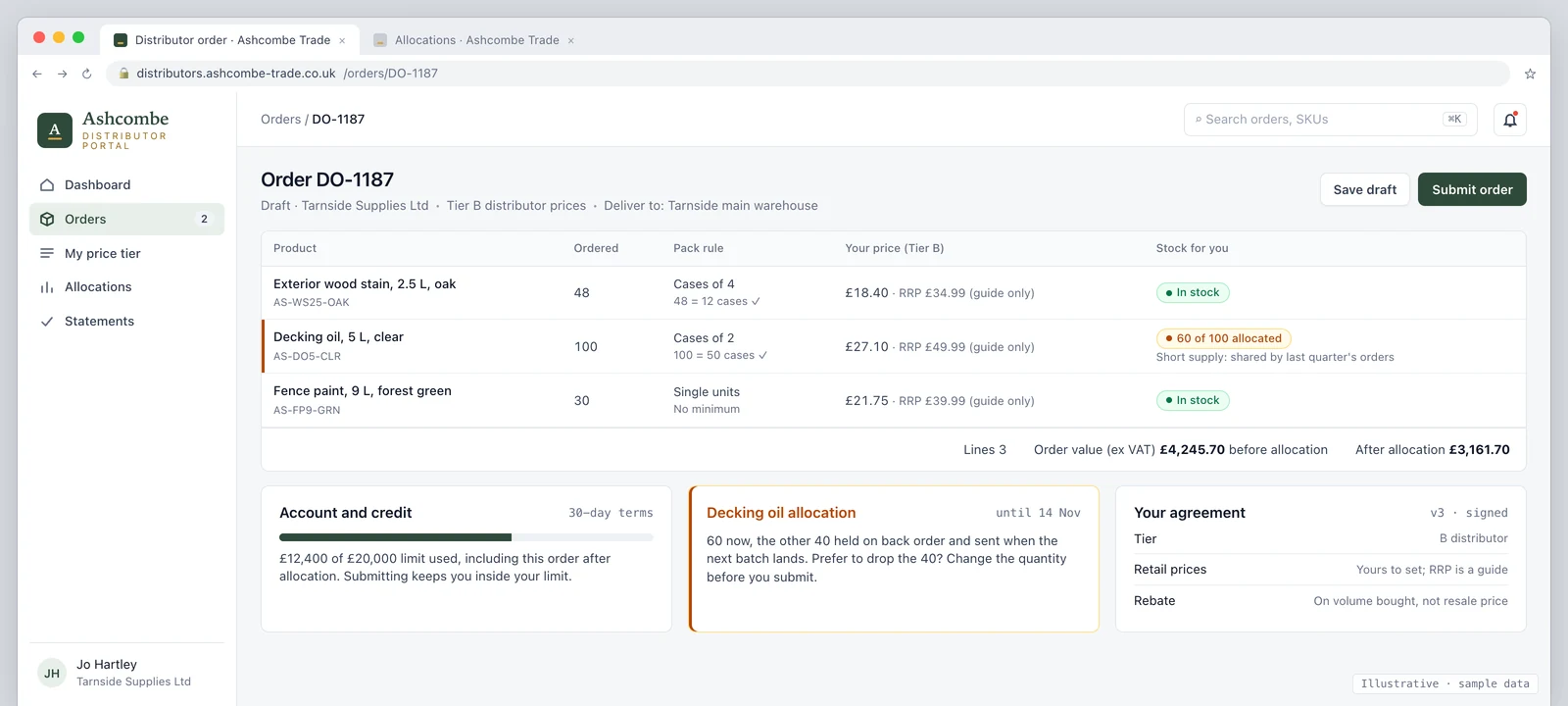
The screen below shows a draft order from a distributor on a mid tier. Pack rules are checked line by line, the short product shows how much has been allocated and when the rest is due, the credit check runs before submit, and the RRP is labelled as a guide. The agreement panel says plainly that retail prices are the distributor's to set and that the rebate follows what they buy.
Allocation: pick one rule and show it
Short supply is where distributor relationships get tested. Without a rule, the loudest distributor gets the stock and the others find out when their order arrives short. Three rules are common, and each has a trade-off.
- Share by past orders. Each distributor gets the same proportion of its recent buying. Fair to steady buyers; hard on a distributor that is growing fast.
- A split agreed in advance. Fixed percentages written into the agreement. Predictable, but needs reviewing as distributors grow or shrink.
- First come, first served, up to a cap. Simple to explain; rewards whoever orders first, which may be whoever saw the stock alert first.
Whichever you choose, the portal should apply it the same way to every account, show the allocated quantity on the order line, and turn the rest into a dated back order the distributor can keep or cancel. Our guide to order status pages covers how to show a back order so it doesn't become a phone call.
Price tiers: one source, not one sheet per distributor
Tier pricing breaks down when every distributor has its own spreadsheet. Someone updates three of them after a price rise and forgets the fourth. Keep one price list, assign each distributor a tier, and let the portal work out the price at the basket. The same applies to the columns behind it: our wholesale price list template sets out the fields a trade price list needs, and the portal cost guide explains why the number of price variations drives the build quote more than the number of products does.
When you don't need a portal
If you have a few distributors who order monthly from a short range, a shared price list and a confirmation email per order will usually do. A portal earns its cost when orders are frequent, when tiers and pack rules cause corrected orders, or when allocation in short supply takes up your team's week. If your distributors already use their own buying systems, ask whether they'd rather send orders in a file you import; a portal they ignore costs more than no portal. If they email purchase orders as PDFs, AI order processing can turn them into draft sales orders a person approves, without asking distributors to change how they buy.
How we'd approach yours
We start with a 20-minute walkthrough of how distributor orders arrive today, then a fit check of your products, customers, price lists and warehouses, and only then a fixed plan and timeline. You get a fixed quote with the full cost known before work starts. The portal we run for a UK wholesaler today covers sales and warehousing; distributor tiers, allocation rules and rebate tracking are things we'd build for you, connected to your accounts software through its official API where it has one. Your code and data stay yours. If a spreadsheet and an email are enough, we'll say so.
Book a 20-minute walkthrough or send us your distributor rules and we'll mark up which ones a portal should carry.
Sources
- Legislation.gov.uk, The Competition Act 1998 (Vertical Agreements Block Exemption) Order 2022, SI 2022/516
- Competition and Markets Authority, Guidance on the VABEO (CMA166), 12 July 2022: 30% market-share threshold, resale price maintenance and indirect means (paragraphs 8.11 to 8.16), active and passive sales (paragraphs 8.45 to 8.46), exclusive distribution (paragraphs 8.54 to 8.57), duration of the order
- Competition and Markets Authority, VABEO guidance PDF
Last reviewed 3 November 2026. This guide explains our own working method and the CMA's published guidance; it isn't legal advice. Competition law depends on your market share and your agreement, so take advice before building any rule on price or territory.