

UAE · Mobile apps
Mobile app development company for UAE businesses: what your app needs and how to compare builders
On this page12 sections
In short: Coded Idea is a mobile app development company that builds iOS and Android apps, in Arabic and English where you need both, with the backend and admin panel behind them, for businesses in the UAE and worldwide. A UAE app has to get four things right before launch: how customers pay, how personal data is handled under the UAE's data protection law, whose name the App Store and Google Play accounts are in, and where the data is hosted. You get a fixed written quote after a scoping call, with no price list and no surprises after work starts. We have no UAE office or trade licence; we work with clients worldwide, and calls and meetings can be arranged to suit you.
This page is for the person choosing who builds the app. It sets out what a UAE project needs, how the work runs from first call to launch, and a tick-list for comparing app development companies, including us. For the general picture (native or cross-platform, what drives cost, store fees) see our mobile app development page.
What a UAE app has to get right
Most app quotes list screens and features. These four areas are where UAE launches slip, because someone outside the development team (a bank, Apple, Google, a legal adviser) has to say yes.
| Area | What to decide early | Who says yes |
|---|---|---|
| Payments | Which gateway, which methods (card, Apple Pay, Google Pay, pay-later), refunds | Your gateway or bank, after its own checks on your business |
| Personal data | What the app collects, the consent wording, how a user deletes their account | You, as the business that decides why data is collected, with your legal adviser |
| App stores | Organisation accounts, privacy answers, a demo login for reviewers | Apple's and Google's review teams |
| Hosting | The cloud region, where backups live, who owns the account | You; some sectors and clients also set their own rules |
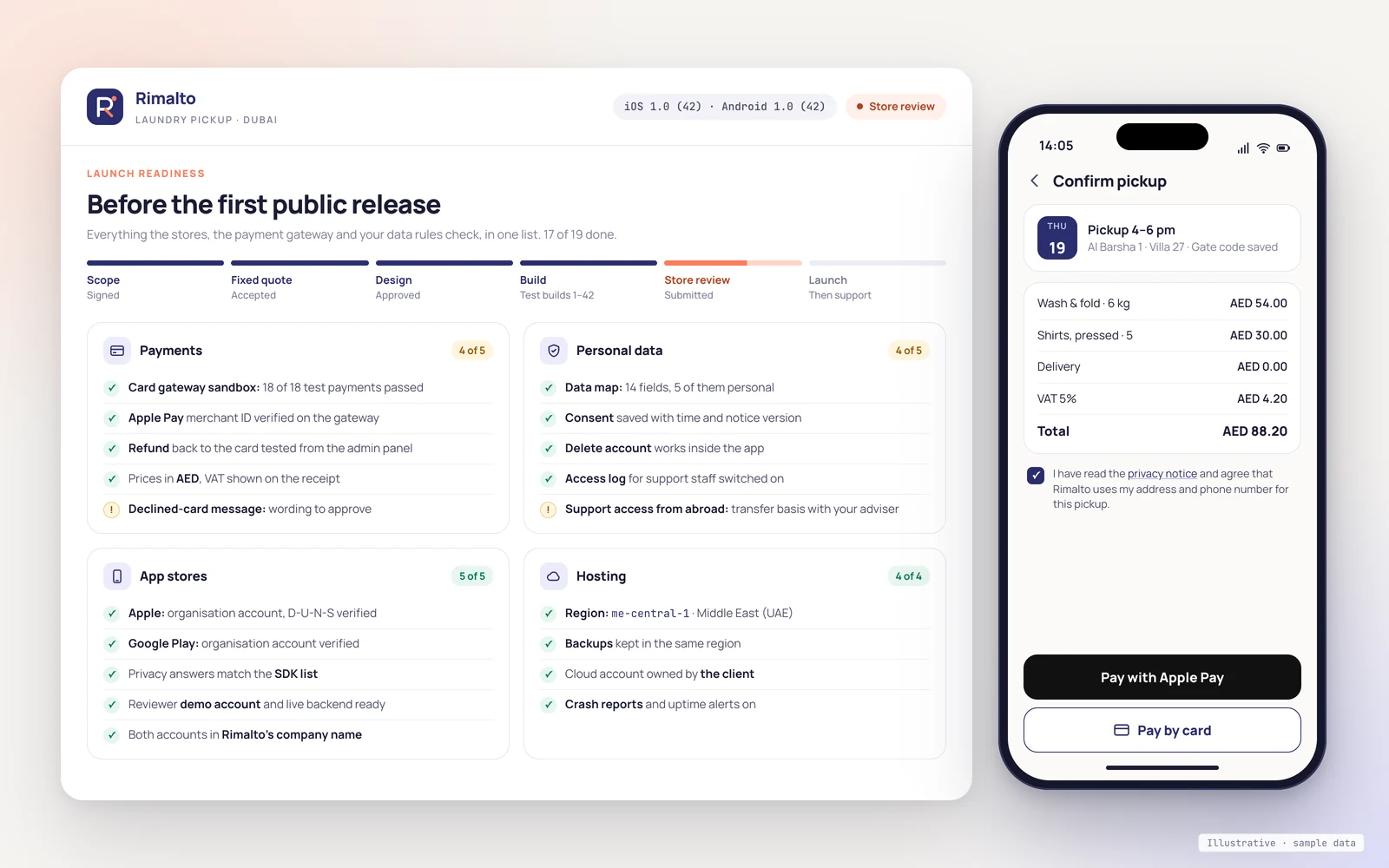
Taking payments in a UAE app
Two decisions come first: which gateway, and whether the stores let you use it for what you sell.
The gateway. Several gateways serve UAE businesses and publish mobile tools. Three examples, from their own documentation opened on 12 November 2026:
- N-Genius Online documents a hosted payment page, a direct API, iOS and Android SDKs, and Apple Pay, Google Pay and Samsung Pay.
- Stripe lists the United Arab Emirates among the countries where businesses can use it.
- Checkout.com lists cards, Apple Pay and Google Pay, plus Tabby and Tamara, and describes Tamara as popular in the UAE and Saudi Arabia.
These are examples from their documentation, not recommendations. Your business signs the gateway contract and passes its checks; we build the app and backend against its API. If your bank already offers a gateway, start there: switching later means a second round of checks and testing.
The store rule. Apple and Google decide which payments may go through an outside gateway. A laundry pickup, a food delivery or a clinic booking is a physical good or service, so it is paid by card or Apple Pay through your gateway. A subscription to content used inside the app usually has to use the stores' own in-app billing, and the store takes a commission. Our app store table has the commission rules and the Apple guideline numbers. Getting this wrong is a common reason for a rejected first submission.
What to test before launch. A successful payment, a declined card, a refund back to the card, a payment that times out, and what the customer sees in each case. Prices should show in dirhams with VAT where it applies; our guide to UAE tax invoice requirements covers what a receipt or invoice must carry.
Personal data: the UAE PDPL in plain terms
The UAE's main data protection law is Federal Decree-Law No. 45 of 2021 on the Protection of Personal Data. The UAE legislation portal lists it as active, issued on 20 September 2021 and in effect from 2 January 2022 (opened on 12 November 2026). What the text says, in brief:
- Who it covers. Article 2 applies it to controllers and processors in the UAE, and to those outside the UAE that process personal data of people in the UAE. An app built or supported from another country is still in scope.
- What it leaves out. The same article excludes, among others, health data and banking and credit data that have their own laws, and companies in free zones with their own data protection rules. The government portal names the DIFC's data protection law as one of these.
- Consent and rights. Processing without consent is prohibited except in listed cases (Article 4). People can ask what data is held and why (Article 13) and ask for it to be corrected or erased (Article 15), and to restrict or stop processing.
- Breaches. Article 9 requires the controller to report a breach to the UAE Data Office, within the period and in the form set by the law's Executive Regulations.
- Transfers abroad. Articles 22 and 23 allow transfers to countries with adequate protection, or under a contract that imposes the law's standards, or with the person's explicit consent, among other cases.
What that means for the build. A data map listing every field the app collects and why; consent wording saved with the time and version the user agreed to; an account-deletion flow inside the app (Apple requires one anyway when people can sign up in the app); access logs for support staff; and a hosting region you chose on purpose. These belong in the scope from the start, not after launch.
This is a summary, not legal advice. Which duties apply to your business, and whether your sector has its own rules, is for your legal adviser. Our guide to the PDPL and developers outside the UAE goes further into transfers and contracts.
Publishing in the App Store and Google Play
Open both developer accounts in your company's name, not the developer's. That keeps the app, its reviews and its download history yours if you ever change who maintains it.
| Apple Developer Program | Google Play Console | |
|---|---|---|
| Account type | Organisation, which must be a legal entity; Apple does not accept trade names or branches | Organisation account |
| Business identifier | A D-U-N-S Number to verify the legal entity | A D-U-N-S Number; Google says you can't create an organisation account without one |
| Fee | 99 USD a year, in local currency where available | One-off registration fee (see our main app page) |
| Before first release | App Review for every version | Personal accounts created after 13 November 2023 must run a closed test with at least 12 testers for 14 days; an organisation account avoids that step |
The D-U-N-S Number is free from Dun & Bradstreet, but it can take time to issue, so apply for it as soon as you decide to build. Apple also asks for a public website on a domain that belongs to your company, and for someone with authority to sign agreements for it.
Two more checks catch first submissions out. Reviewers need a working demo login and a live backend. And the privacy answers you give each store must match what the app and every library in it really collect, so we prepare those from the data map above.
Calling features. If your app includes voice or video calls, check the rules first. The UAE's telecoms regulator, the TDRA, treats internet calling as a regulated service that licensees, their partners or TDRA-approved applications may offer. Chat, photos and voice notes inside an app are a different matter; live calling needs advice before it is built.
Hosting and data residency
You choose the region; we set up the hosting in an account in your company's name. Two of the large cloud providers run regions in the UAE:
- AWS: Middle East (UAE), code me-central-1. It is an opt-in region, so the account owner has to switch it on before anything can be built there.
- Microsoft Azure: UAE North in Dubai and UAE Central in Abu Dhabi. Microsoft marks UAE Central as restricted access, for specific cases such as disaster recovery.
Hosting in the UAE is often the simplest answer when you serve UAE customers, but it is a choice, not an automatic rule for every app; the transfer routes above exist for data that is processed elsewhere. Some clients, especially in government work, health and finance, set their own residency requirements in their contracts. Ask about them before the quote, because they change the hosting plan and the price.
Arabic and English apps, right to left
We build and test apps in Arabic and English, with right-to-left (RTL) layouts. In a real build, that covers six things:
- Mirrored layouts and navigation. In Arabic the screen flips: text and menus align to the right, back arrows point the other way, and tab order and swipe directions reverse. The standard iOS and Android components do much of this (Apple's right-to-left guidelines, Android's guide to languages and RTL), so we lay screens out by start and end rather than fixed left and right, then check the parts that don't flip by themselves: custom charts, sliders, progress bars and image carousels.
- Arabic fonts and text. A font with full Arabic letterforms in every weight the design uses, letters that join correctly, and line heights with room for Arabic marks, so text isn't clipped in buttons and cards.
- Arabic mixed with numbers and Latin names. An order number, a price in dirhams, a phone number, an email or an English brand name inside an Arabic sentence has to keep its own order. Apple's guidelines say the digits of a number are never reversed; we agree with you whether the app shows Western or Eastern Arabic numerals.
- Arabic content in the admin panel. Your team enters product names, descriptions and notifications in both languages, in right-to-left text fields with a preview, and the app shows a clear fallback when a translation is missing.
- Testing in both languages. Each test build is checked in English and in Arabic, on iPhone and Android, with the phone set to each language, long Arabic strings and mixed-language input.
- Store listings in Arabic. App Store Connect and Google Play Console both list Arabic for store listings, so the name, description and screenshots can be published in Arabic and English.
Tell us at the scoping call who writes the Arabic text, your team or a translator, so the quote covers the right work.
How a project runs, from first call to launch
Every stage ends with something you can see or sign. We don't put week counts on a page like this, because they depend on the scope; the written quote gives your dates.
- Scoping call. Twenty minutes. You show us the idea, a sketch or an app you'd like yours to work like. We ask who uses it, how they pay and what systems it must talk to.
- Written scope and fixed quote. The screens, user roles, integrations and what is out of scope, with one price for the build and run costs (store fees, hosting, gateway charges) as separate lines.
- Design. Screen designs for you to approve before the build starts.
- Build in stages. Test builds installed on your own phone at each stage, so you see real progress, not status reports.
- Store submission and review. Privacy answers, screenshots, a demo account for reviewers, and room in the plan for a resubmission.
- Launch and support. We train your team, stay close through the first weeks and keep supporting the app after launch, including the yearly iOS and Android updates.
How quotes work
There is no price list for apps on this page, because there is no honest single number: a booking app with one user role and a marketplace with customers, drivers and an admin panel are different projects. After the scoping call you get one fixed price for the agreed scope, and anything added later is quoted before it is built.
A good quote, from us or anyone else, separates:
- the build: app screens, backend, admin panel and integrations;
- one-off costs: developer accounts, design assets, any licences;
- running costs: hosting, gateway fees, push notifications, maps or SMS if used;
- support after launch: what is included and what is charged.
If a quote lumps those together, ask for them split. The cost drivers table on our mobile app development page shows what moves the build price most.
Compare app development companies: a tick-list
Use this on every company you talk to, including us. Tick what each one has actually shown or put in writing, not what the website says.
Your ticks go into the message for you to read and edit. Nothing is sent until you press send in the form or in WhatsApp.
This runs in your browser. Nothing you tick is sent anywhere unless you choose to send it.
What app development companies publish (checked 12 November 2026)
Several companies that sell app development in the UAE publish dirham figures. We opened each company's own page on 12 November 2026 and took the figure it shows for its entry tier. Read the scope column before the number: the tiers are not the same size.
| Company | Published figure | Scope it describes | Timeline it states | Source |
|---|---|---|---|---|
| SISGAIN | AED 25,000–60,000 (about US$6,800–16,300) | Basic app: simple screens, user login, a clean interface | 2–3 months | sisgain.ae |
| Techugo | AED 30,000–80,000 (about US$8,200–21,800) | Simple app | 2–4 months | techugo.com |
| Orbix Studio | AED 30,000–80,000 (about US$8,200–21,800) | MVP for a startup validating an idea | 6–10 weeks | orbix.studio |
| DXB Apps | AED 150,000–375,000 (about US$40,800–102,100) | Simple app: login, content features and the interface | Not stated | dxbapps.com |
| eCorpIT (US dollar price list, not specific to the UAE) | From US$8,000 for a cross-platform MVP; US$15,000 for a standard MVP | Cross-platform MVP: 5–7 screens, Firebase or Supabase backend, store submission. Standard MVP adds a custom backend and payments | 6-week build; 8-week build | ecorpit.com |
Approximate US dollar amounts are ours, not the companies': the dirham is pegged at AED 3.6725 to US$1, the rate the Central Bank of the UAE listed when we checked on 12 November 2026, and we rounded to the nearest US$100.
Published figures differ in scope and change often; they are not our prices. Ask us for the price of your app below.
Price for your app
See the price for your app
Tell us what you need and we send you a price for your app and a fixed written quote after a short scoping call.
- Tell us what you need
- Short scoping call
- Price and fixed written quote
Items ticked above: 0. They are in the message below, ready for you to edit.
Prefer WhatsApp? Send the same request there.
Ask for the price on WhatsAppWho you would work with
Coded Idea was founded in 2020 and has delivered more than 100 projects. We build web and mobile apps, AI agents and custom software, and we work with clients worldwide; calls and meetings can be arranged to suit you. The system we can show you running live is a trade portal covering sales and warehousing; for that kind of business we also build a sales rep ordering app on top of it.
An example from our work
We don't name clients, so here is one app project with the client's details left out. The same building blocks (camera, on-screen signature, location and an admin panel) come up in delivery and field-service apps anywhere.
- For a container trucking company in the United States, we built the dispatch system the office runs on every day: a web admin panel, a back-end API and a driver app for iPhone and Android.
- The driver app records proof of delivery on the phone (a delivery photo and the customer's signature drawn on screen) and will not let a driver complete a delivery until both are captured.
- While a driver is on duty, the app shares the truck's location with dispatch, so the office can see where each load is; sharing stops when the driver goes off duty.
What we don't claim: a UAE office, a UAE trade licence, UAE clients we can name, awards or ratings. We are not a payment gateway, a law firm or a tax adviser. If an app development company tells you it is the top one in Dubai, ask it for the evidence, and ask us for ours.
Apps for UAE businesses often sit next to other work. A WhatsApp channel for orders and questions is covered on our AI automation for UAE businesses page and in our guide to WhatsApp Business API costs in the UAE. Our UAE page lists everything we build for UAE companies, including e-invoicing links to your accounting system.
Sources
All opened on 12 November 2026.
- UAE legislation portal, Federal Decree-Law No. 45 of 2021 on the protection of personal data (Articles 2, 4, 9, 13, 15, 22 and 23).
- UAE government portal, data protection laws.
- TDRA, frequently asked questions on VoIP services.
- Apple, Apple Developer Program enrollment.
- Google, Play Console account types and D-U-N-S and testing requirements for new personal accounts.
- Apple, Human Interface Guidelines: right to left and App Store localizations; Android Developers, support different languages and cultures; Google, translate and localize your app.
- AWS, Regions list; Microsoft, Azure regions list.
- N-Genius Online developer documentation; Stripe, global availability; Checkout.com, payment methods.
- The five company pages linked in the table of published figures, and the Central Bank of the UAE's exchange rates page (US dollar 3.6725).
Where a source above does not say something, we have not claimed it. Store rules, gateway features and cloud regions change; check them again before you sign anything.