

Guide · UAE e-invoicing
UAE e-invoicing for small business: what to do before 31 March 2027, and when
On this page7 sections
Short answer: if your revenue is under AED 50 million, you must appoint an Accredited Service Provider (ASP) by 31 March 2027 and be issuing e-invoices by 1 July 2027. Those two dates come from Ministerial Decision No. 244 of 2025, Article 5(1)(b), and they haven't been changed. Below, you can enter today's date and get the countdown, then work through the preparation list. The page is built from the decision text and the Ministry of Finance's Guidelines, not from vendor blogs, because the vendor blogs disagree with each other on the details that matter.
If you are at AED 50 million or more, your dates were earlier (appointment by 30 October 2026, go-live on 1 January 2027), and our ERP integration guide is the better starting point.
The dates and what each one means
| Date | What it is | Source |
|---|---|---|
| 1 July 2026 | Voluntary start for anyone, with penalties not applying until your mandatory date | Decision 244, Article 4; Guidelines 8.2 |
| 31 March 2027 | Last day to appoint an ASP (revenue under AED 50m) | Decision 244, Article 5(1)(b) |
| 1 July 2027 | Last day to implement e-invoicing (revenue under AED 50m) | Decision 244, Article 5(1)(b) |
| 1 October 2027 | Government entities go live (they appoint by 31 March 2027 too) | Decision 244, Article 5(1)(c) |
There are 92 days between the two small-business dates. That sounds like breathing space, but the appointment is not just a signature. The Guidelines (Appendix 1) describe the order: understand the rules, select an ASP, onboard through the FTA's EmaraTax portal, then test. The onboarding is started by you, not the ASP, and each person onboards with only one ASP.
One quirk is worth knowing before you quote dates to anyone. The Guidelines' table (section 8.3) shows the first-phase appointment date as 31 October 2026, while Ministerial Decision No. 66 of 2026 says 30 October 2026. For the small-business row the two documents agree, so nothing here changes, but it is a reason to quote the decision, not a summary of it.
Which revenue counts
The decision defines Revenue as the gross income earned during your most recent Accounting Period, based on financial statements prepared under UAE law, or, if those aren't available, other documentation the Authority accepts. "Accounting Period" is the period for which you must prepare financial statements. Three practical points follow:
- It is gross income, not profit and not only VAT-taxable sales. Don't use your VAT return turnover and assume it matches.
- It is the most recent period. A business that crosses AED 50 million in its next set of accounts doesn't change phase mid-year on this wording, but the decision doesn't spell out what happens on that move. Ask the FTA in writing if you are close.
- The wording covers the case where no statements exist yet, but it doesn't give a figure. A new business should ask the FTA which documents it accepts.
We don't give tax advice, so we stop there. The boundary is the one that matters most to get right: AED 50,000,000 or more is phase one, under AED 50,000,000 is phase two.
Four things small businesses often assume wrongly
"I'm not VAT registered, so I'm out." The Guidelines (section 6.1) say all persons who make a business transaction in the UAE are in scope notwithstanding their VAT registration status. The exclusions (sovereign activities, certain airline supplies, exempt financial services) are in Chapter 7 and don't include "small" or "unregistered". The one broad carve-out is business-to-consumer sales: a person who only sells to consumers isn't subject to the system until the Minister decides otherwise (Article 5(2)).
"My customers aren't ready, so I can wait." Section 6.1 says a customer's e-invoicing onboarding status or tax registration status doesn't affect your obligations on a transaction. The Guidelines also say a buyer who hasn't implemented e-invoicing may still ask you for a separate tax or commercial invoice, for example to support input tax recovery. Expect to run both for a while.
"The ASP does everything." The ASP carries the invoice across the network and reports tax data to the FTA. It can't create data your system doesn't hold. The Guidelines (Appendix 1, step 1) tell you to run a gap analysis and make sure your accounting, ERP or invoicing system can generate and extract every data point an e-invoice needs. For a small business that is usually the longest job, because customer tax numbers, item descriptions and credit-note references live in spreadsheets and people's heads.
"A late start is a small fine." Not appointing an ASP is the first row of the penalty table in Cabinet Decision No. 173 of 2026: AED 5,000 the first time and AED 5,000 for every further month or part month, capped at AED 50,000 in any 12 consecutive months. Voluntary users escape penalties until their mandatory date, but you can't wait past it.
Countdown planner and preparation checklist
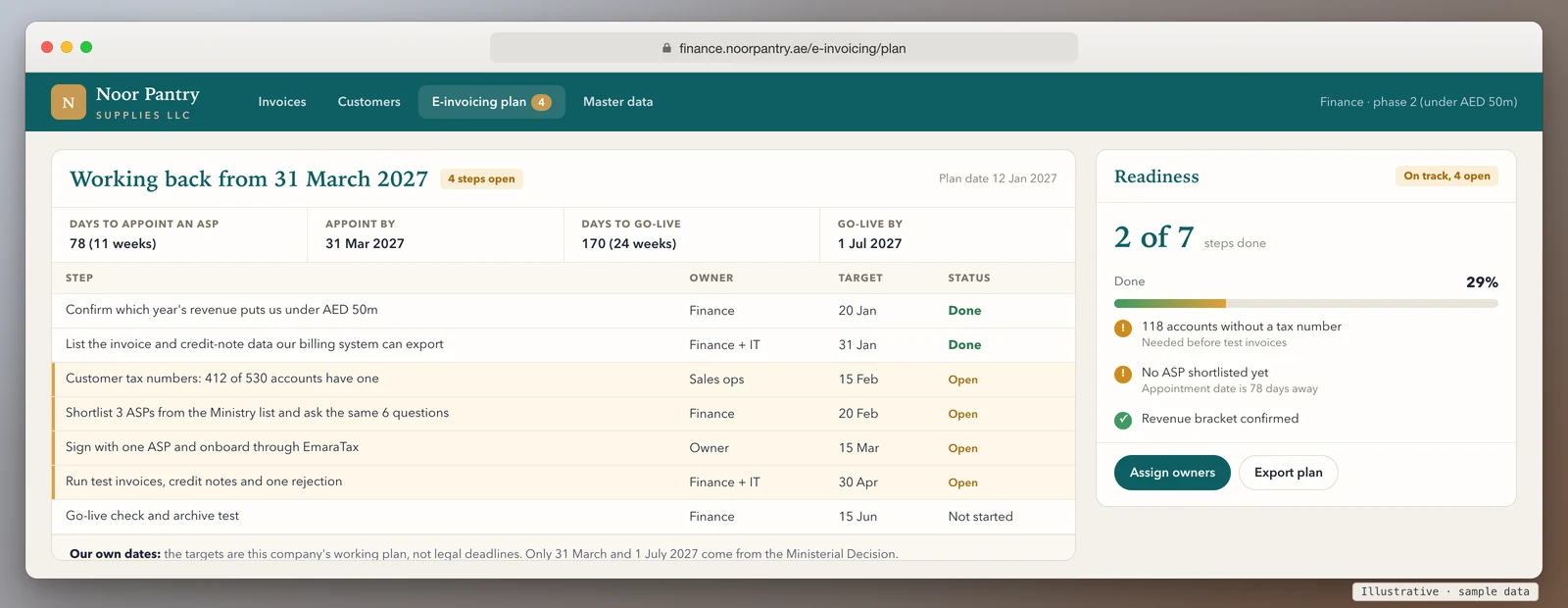
Enter today's date, say which revenue bracket you are in, and tick what you have already done. The planner counts the days to both dates and gives you a working-back schedule. Those intermediate dates are our suggestion for planning, not legal requirements.
Your answers go into the message for you. Add your name and email and we reply by email. Nothing is sent until you press send.
This runs in your browser. Nothing you enter is sent anywhere unless you choose to send it.
A working-back schedule (our suggestion)
The law gives you two dates. Working back from them, this is the order we would use, with the gaps you'd allow for a business of this size. None of it is a legal requirement.
| Roughly | Step | Why this order |
|---|---|---|
| 12+ weeks before 31 March | Confirm bracket; list the data your system can export; collect customer tax numbers | The slowest work and the least dependent on the ASP |
| 8 weeks before | Shortlist ASPs from the Ministry's list and put the same questions to each | ASPs differ on integration, retention and price |
| 4 weeks before | Sign with one ASP; start onboarding in EmaraTax | The legal step. Finish it early so the date is not the day you sign |
| Between 31 March and 1 July | Test invoices, credit notes, a deliberate rejection, a received supplier invoice, archive retrieval | This is where a 12-case test plan earns its keep |
| Before 1 July | Check format fields, TIN and Peppol ID set-up | See the format guide |
What your billing system has to hold
Whatever ASP you choose, it receives data from your system. The Guidelines' retention section (5.4) also requires records to be kept for 5 years following the tax period and be retrievable for the FTA. For a small business, the gaps we expect to find first are:
- Customer identifiers. Business buyers need a tax identifier on file. The Guidelines give a fixed placeholder endpoint for buyers not subject to the framework (0235:9900000098), so you need to know which of your customers are which.
- Credit notes tied to invoices. A credit note raised from a spreadsheet or by hand needs a reference to the original document that a system can send.
- Structured invoice data. An e-invoice is XML. A PDF produced by a template can't be turned into one.
- Where the rejections go. If an ASP rejects an invoice, someone must see it and resend it. Under Cabinet Decision 173 each invoice not issued and sent through the system costs AED 100, so an unseen rejection is a cost.
If you invoice from Zoho, Xero, QuickBooks, Tally, Odoo or SAP Business One, see what each vendor offers in our vendor guides and Odoo, SAP and Zoho guide before you ask an ASP for a quote.
How we help
We're a software company with a development team in India, and we work with UAE businesses remotely. We aren't an Accredited Service Provider, a tax adviser or a partner of any ASP. We build: we change your billing system, ordering portal or spreadsheet process so it holds the data an ASP needs, sends invoices and credit notes to the ASP you chose, and puts rejections in a queue someone owns.
You get a fixed quote after a 20-minute call, so the full cost is known before work starts. Book a call or ask for a price.
Sources
- Ministerial Decision No. 244 of 2025 on the Implementation of the Electronic Invoicing System (read 10 November 2026): Articles 1, 2, 4 and 5
- Ministerial Decision No. 66 of 2026 (changes only the phase-one appointment date; read 10 November 2026)
- Ministry of Finance, UAE Electronic Invoicing Guidelines, Version 2.0 (26 October 2026; read 10 November 2026): sections 5.4, 6.1, 8.2, 8.3 and Appendix 1
- Cabinet Decision No. 173 of 2026 (penalty row 1) as set out in our penalties guide, with the text on uaelegislation.gov.ae
- Federal Tax Authority, notice on the e-invoicing deadlines (October 2026)
Last reviewed 10 November 2026. This guide explains published rules and the Ministry's guidance and isn't legal or tax advice. If your revenue is close to AED 50 million, ask the FTA or your tax adviser which figure applies to you.